Travel to Budapest
Day 2 Jewish Quarter, Andrássy út
We started the afternoon touring the Jewish quarter of Budapest. We started the tour through the market located in the Klauzál Tér, although we were disappointed, for having very little life. The Kazinczy street synagogue was built in 1911 for the Orthodox Jewish community, although it was rebuilt in 1945 due to the damage suffered during the Second World War. Gozsdu-udvar is a set of seven buildings and their courtyards that can be accessed from Király, Dob and Holló streets. The 7 original buildings were part of the Jewish ghetto that existed from November 1944 to January 1945. In 1952, the buildings and courtyards became the property of the State. Nowadays it is known for its cafes, bars, pubs, galleries and exclusive shops.
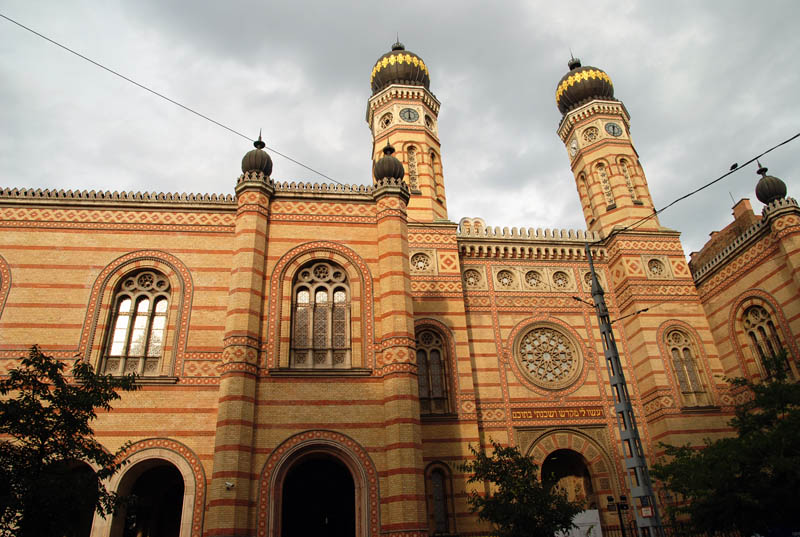
Budapest - The Great Synagogue
We continue our walk through the second synagogue in the neighborhood, the Rumbach street synagogue, built in 1872 in Moorish style. The interior is octagonal, with balconies, painted in Islamic style and culminated by a beautiful vault. The Great Synagogue of Budapest, also known as the Synagogue of Dohány Street is the largest synagogue in Eurasia and the second largest in the world. This temple is 75 meters long and 27 meters wide and was built between 1854 and 1859 in the Moorish revival style. It has two domes located each on the two octagonal towers of 43 meters high, in addition to a window in the form of a rosette located on the main entrance. The complex of the Great Synagogue is formed by the synagogue itself, in addition to the Jewish Museum, the Heroes' Temple, the Jewish cemetery and a memorial dedicated to the Holocaust.
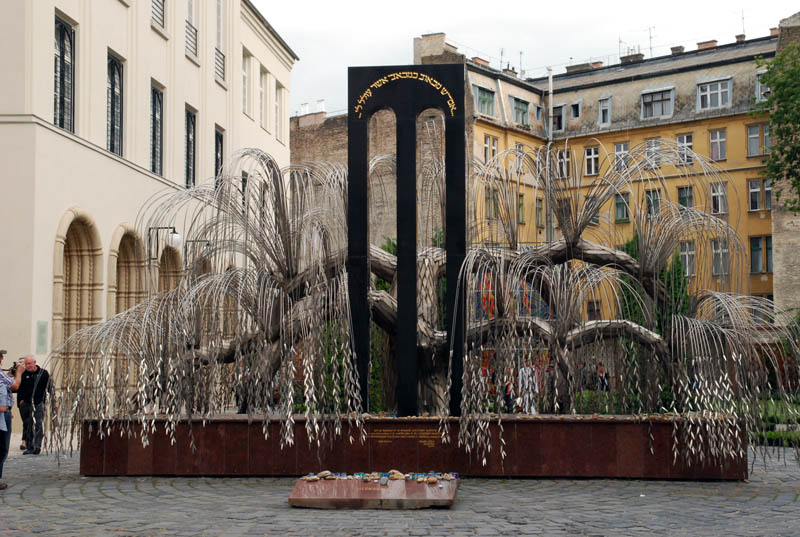
Budapest - Holocaust memorial
The gallery and Heroes' Temple, with capacity for 250 people, is used as a memorial for all those Hungarian Jews who lost their lives during the First World War. The cemetery is located in the back garden of the Heroes' Temple. Because the synagogue was part of the Jewish ghetto it had to give shelter to part of the Jewish community. More than 2,000 people had to be buried in the synagogue facilities, even though this goes against the traditions of the Jewish people. The "Raoul Wallenberg" Emlékpark (memorial park) holds the Memorial to the Hungarian Jewish Martyrs - at least 400,000 Hungarian Jews were murdered by the Nazis. Built by Imre Varga, it resembles a weeping willow whose leaves bear inscriptions with the names of the victims.
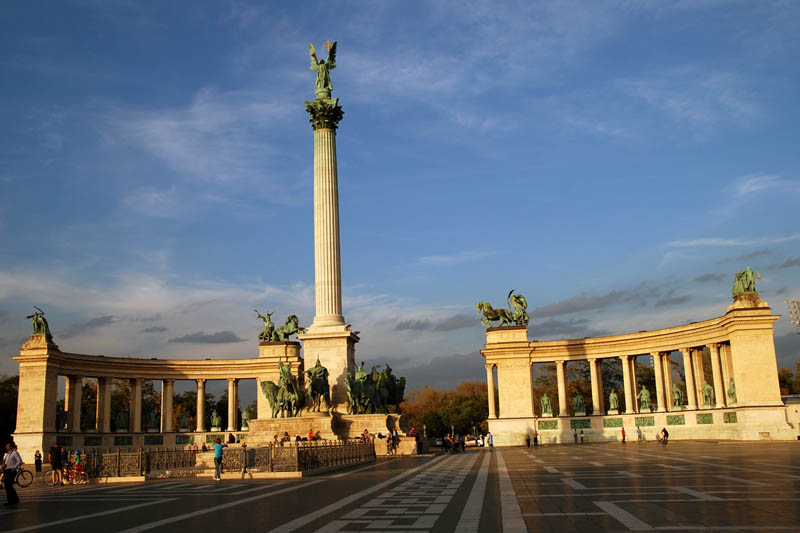
Budapest - Heroes square
After passing in front of the building of the Liszt Ferenc Music Academy, built in 1907 in Art Nouveau style, we observe its facade dominated by the statue of Liszt. Andrássy Avenue (Andrássy út), flanked by eclectic neo-Renaissance houses and palaces that present beautiful facades, staircases and interiors, was recognized as a World Heritage Site in 2002 - along with metro line 1, Hősök tere and Városliget. After its inauguration in 1877, aristocrats, bankers, land owners and historic families moved there to live there. The first part of the avenue, up to Oktogon, besides the opera building, houses many luxurious fashion boutiques.
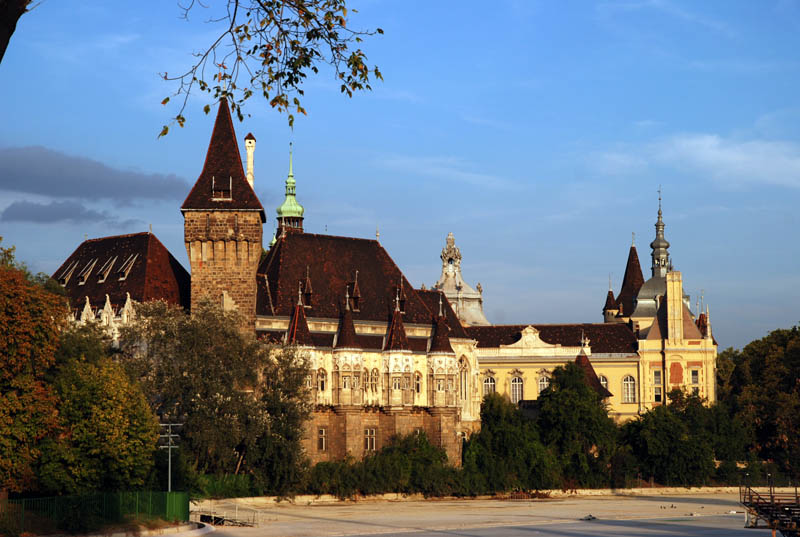
Budapest - Vajdahunyad castle
We walk along the avenue, passing the modern building of the House of Terror (Terror Háza), which commemorates the two main oppressive regimes in Hungary, fascism and communism, and their victims. At the end of the avenue we find the Heroes' Square (Hősök tere), it is surrounded by two important buildings with neo-classical facades, the Museum of Fine Arts on the left and the Palace of Art (or more accurately Hall of Art) on the right. In the center of the square stands the Millennium Memorial, with statues of the leaders of the seven Magyar tribes who founded Hungary in the 9th century and other personalities of Hungarian history.
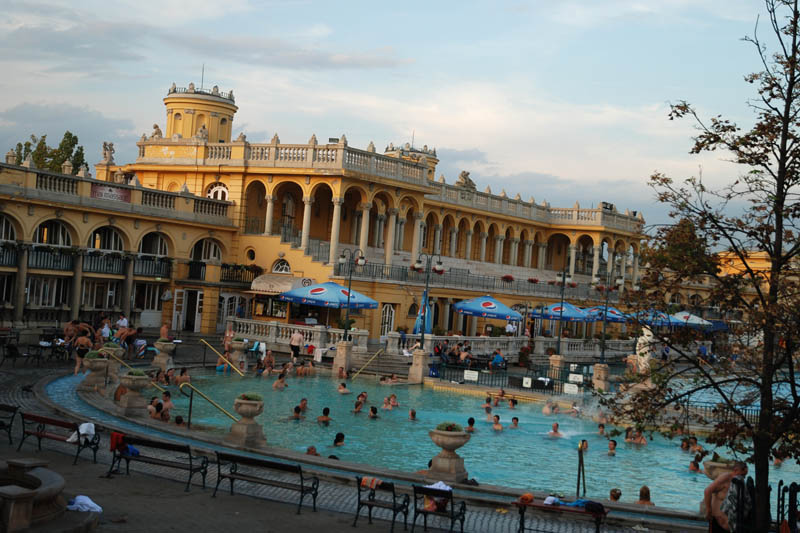
Budapest - Széchenyi termal baths
We arrived at the city park, where we contemplated the castle of Vajdahunyad. It was built between 1896 and 1908 according to the design of Ignác Alpár. In part, it is a copy of the castle of Hunyad, in Transylvania, Romania, We ended the day relaxing in the Széchenyi baths. They were built in 1913 in neo-baroque style, although the complex was expanded in 1927 and still has 3 outdoor and 15 indoor pools. They are the largest medicinal thermal baths in Europe. Its water is supplied by two thermal water sources, with temperatures of 74 °F (25 °C) and 77 °F respectively.