Travel to Budapest
Day 3 Parliament, Belváros
We went to Parliament early, but, being a very popular attraction, they gave us tickets for the early afternoon. The Hungarian Parliament Building is situated in Kossuth Square, in the Pest side of the city and on the banks of the Danube. It is currently the largest building in Hungary. It was designed by Hungarian architect Imre Steindl in neo-Gothic style and built between 1884 and 1902. The Parliament Building is built in the Gothic Revival style; it has a symmetrical façade and a central dome. The dome is Renaissance Revival architecture. Also from inside the parliament is symmetrical and thus has two absolutely identical parliament halls of which one is used for politics, the other for guided tours. It is 268 meters long and 123 meters wide.
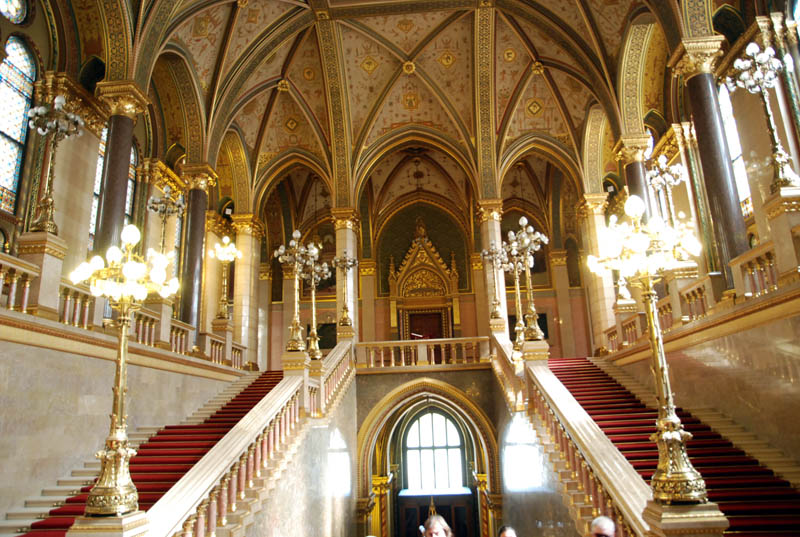
Budapest - Parliament staircase
The interior is decorated with marble and gold. When entering the Parliament, visitors can walk up great ornamental stairs, see frescoes on the ceiling and pass by the bust of the architect, Imre Steindl, in a wall niche. Other statues include those of Árpád, Stephen I and John Hunyadi. One of the famous parts of the building is the hexadecagonal (sixteen-sided) central hall, with huge chambers adjoining it: the Lower House and the Upper House. The modern National Assembly is unicameral and meets in the Lower House, while the Upper House is used as a conference and meeting room.
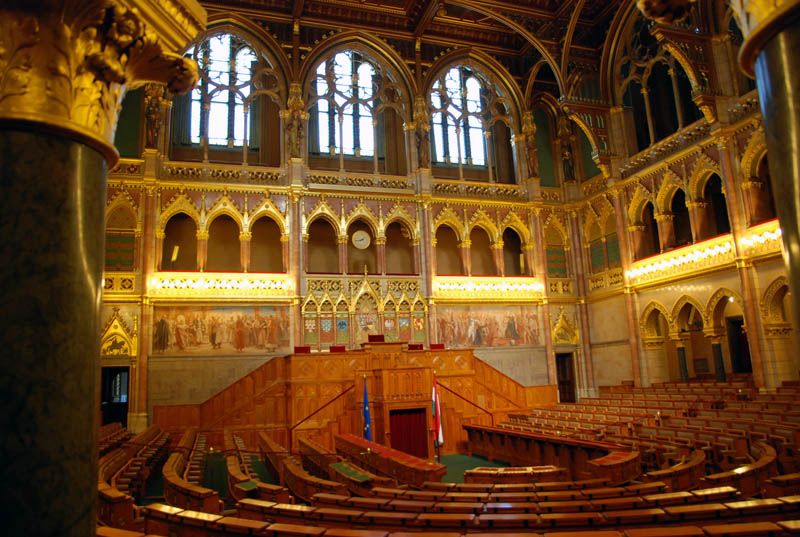
Budapest - Assembly hall
The Holy Crown of Hungary, which is also depicted in the coat of arms of Hungary, the scepter, the orb and the Renaissance-style sword have been displayed in the central hall since 2000. From there you also can see the dome from within, various statues of Hungarian kings, such as St. Stephen or Stephen I, first king of Hungary.
Kossuth Memorial is public monument dedicated to former Hungarian Regent-President Lajos Kossuth in front of the Hungarian Parliament Building on Lajos Kossuth Square in Budapest. The memorial is an important Hungarian national symbol and scene of official celebrations. In the same square we can find other interesting buildings, as the Ministry of Agriculture or the Ethnographic museum. On the other side of the square we find the Francis II Rákóczi equestrian statue.
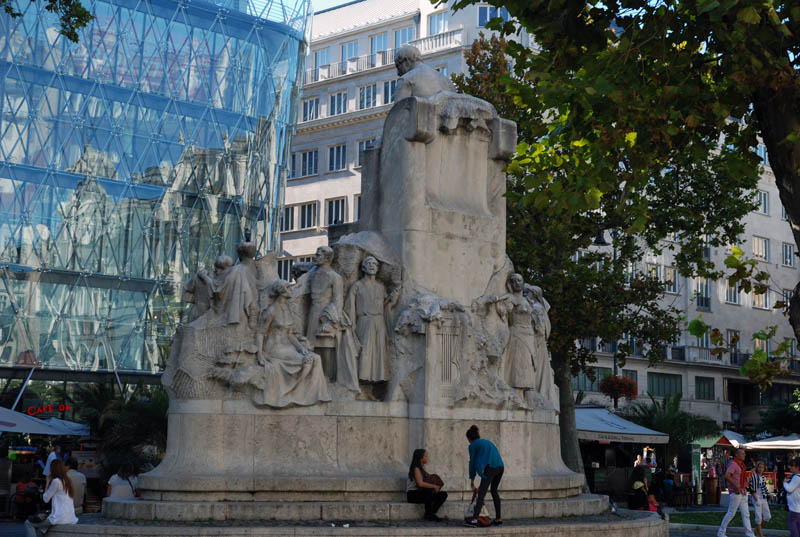
Budapest - Vorosmarty square
We move to the neighborhood of Belváros, also in Pest. Budapest's main shopping street, Váci utca ("Váci Street") is located in this district, as is the large part of the city's commercial life, banks and travel agencies. On one side of the bridge "Erzsébet híd" we find the Parochial Church of the Assumption of the Virgin, the oldest building in Pest, built in the XII century in Romanesque style, although over the centuries it has incorporated different styles. We continue along the commercial street Váci until we reach the Vorosmarty square. In the center of the square, facing west is a statue of the poet Mihály Vörösmarty, from whom the square took its name. Behind the monument there is a fountain flanked by stone lions.
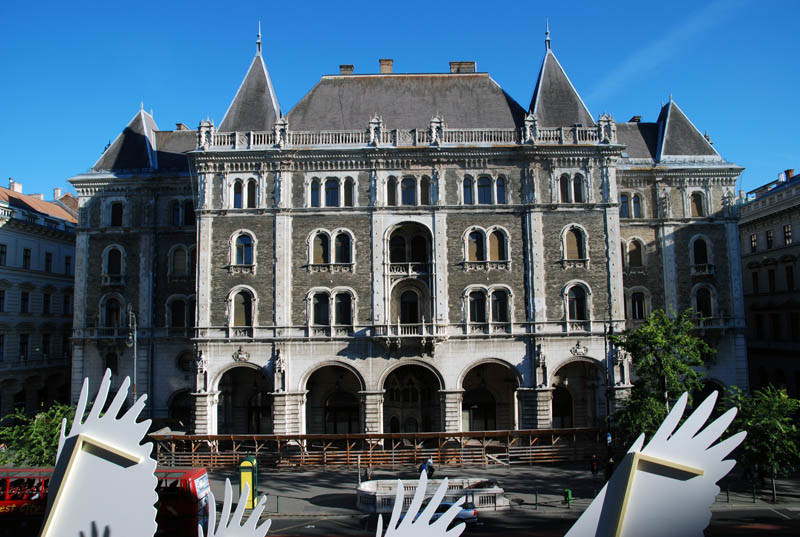
Budapest - Drechsler palace
We start our way back to the hotel, but not before we stop to visit two more buildings on Andrássy Avenue. The Neo-Renaissance style building, known as the Drechsler Palace, is located at number 25 on Andrássy Avenue. It was built on the plans of Ödön Lechner and Gyula Pártos. From 1949 to 2002, the State Ballet Institute and its successor, the Hungarian Arts College of Dance, operated here. Right in front is the building of the Hungarian National Opera (Magyar Állami Operaház).
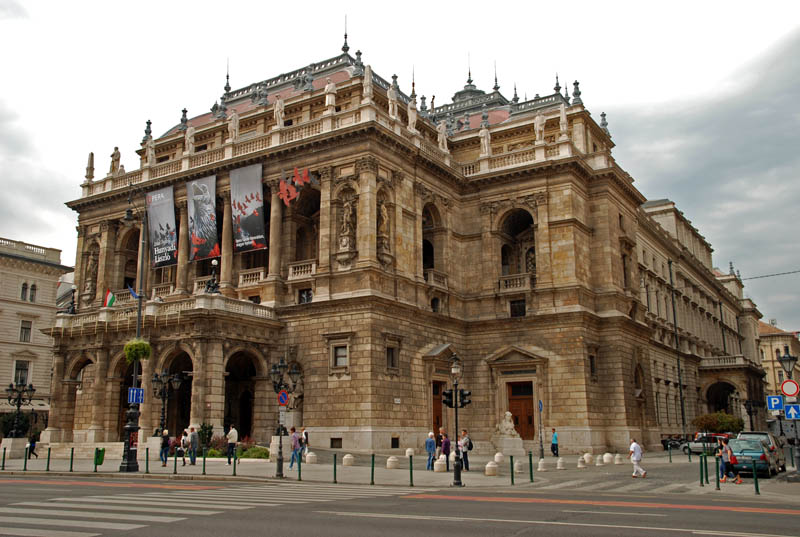
Budapest - State Opera House
The Hungarian State Opera House (also National Opera of Hungary) is a Neo-Renaissance opera with neo-baroque elements. Designed by Miklos Ybl, the horseshoe-shaped theater was opened in 1884 in the presence of Emperor Franz Joseph I of Austria-Hungary and housed a capacity for 2,400 spectators, although its capacity currently stands at 1289 spectators. It is considered one of the most beautiful theaters in the world. Facing the facade are the statues of Ferenc Erkel, national innovation composer, and classical composer Franz Liszt. Gustav Mahler was the director from 1888 to 1891. In our opinion, the visit to the building is worth it, but the "concert" that we bought as an extra was a singer who sang arias helped with music from a radiocassette. Our advice is to skip this last part.