Travel to Ireland
Day 8 Galway, Limerick, Adare (231 Km.)
(in 27 Km.) Galway: We start the visit of the city at Eyre square. In 1965, the square was officially renamed "John F. Kennedy Memorial Park" in honour of U.S. President John F. Kennedy; despite the renaming, the square is still widely known as Eyre Square. Kennedy had visited Galway city and made a speech in the square on 29 June 1963. There is a portrait bust of U.S. President John F. Kennedy in the park. The Browne doorway is also another attraction in Eyre Square; it was originally the doorway of the Browne family's home on Lower Abbeygate Street, but was moved in 1905 from Abbeygate Street to Eyre Square. Adjoining to the square is the nearby shopping area of William Street and Shop Street.
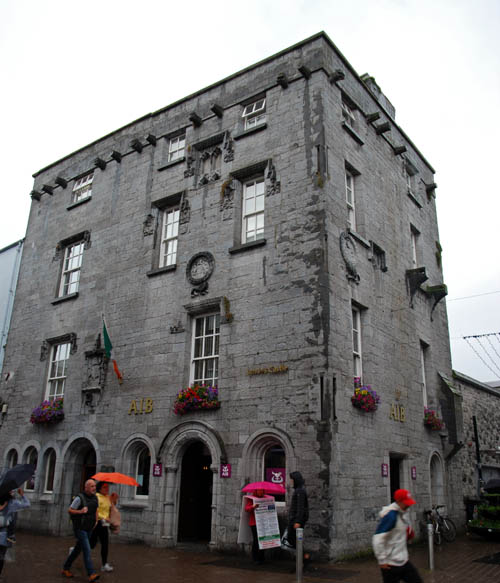
Galway - Lynch´s Castle
We advance by William st. and on the corner with Upper Abbeygate St we find the Lynch Castle, a medieval house built in the 16th century by the prosperous Lynch family, one of the 12 Galway tribes. In Market st. We found the Lynch Memorial Window. A legend states that James Lynch, during his term as mayor, sentenced his son to death for "broken trust" and murder of "a stranger", and personally hanged him from a window of his own house. By the eighteenth century, the site of the hanging was identified as a house in Lombard Street whose facade included stones inscribed with the date 1624, a skull and crossbones. In 1844, the house in Lombard Street was demolished, and the inscribed stones were retained by a committee. In 1854 was set in a specially constructed imitation house-front set in a wall of St. Nicholas´ churchyard.
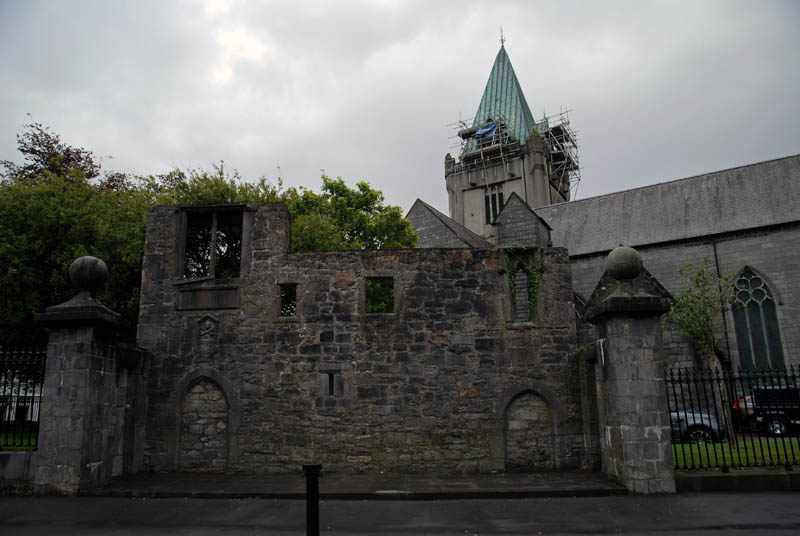
Galway - Lynch Memorial Window
We protect ourselves for a while from the rain visiting the Collegiate Church of St. Nicholas, a medieval church building founded in 1320 and dedicated to Saint Nicholas of Myra, the patron saint of seafarers, in recognition of Galway's status as a port. We continue along High st. until we reach the Corrib river, where we find The Spanish Arch, two remaining arches on the Ceann an Bhalla ("Front Wall"). The two arches were part of the extension of the city wall from Martin's Tower to the bank of the River Corrib, as a measure to protect the city's quays. It was constructed during the mayoralty of Wylliam Martin in 1584. Until 2006, part of the Arch housed the Galway City Museum. At that time, the museum was moved to a new, dedicated building located just behind the Arch.
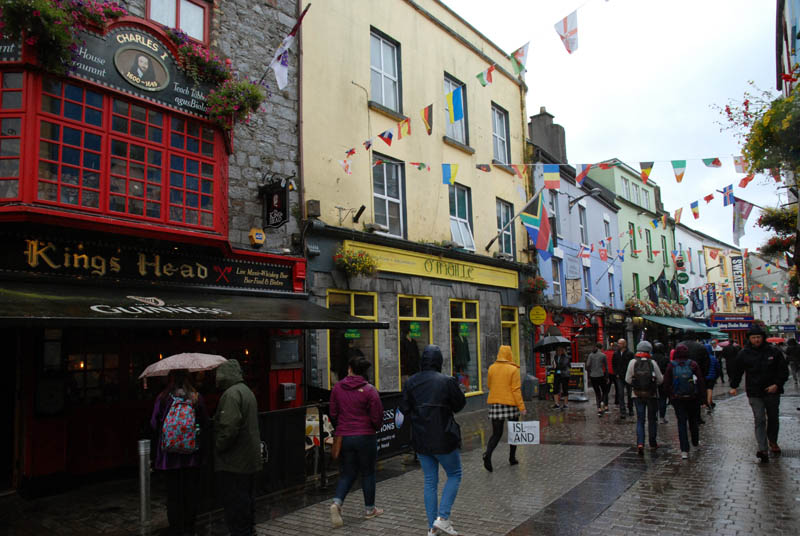
Galway - High street
(in 85 Km.) Bunratty castle: Bunratty Castle was built in 1425. It is located in the municipality of Newmarket-on-Fergus, in Clare County. With its building style called Norman architecture, it is located in the center of the town of Bunratty, along the N19, between the cities of Limerick and Ennis, The castle has undergone a careful restoration, and its interior has been furnished with tapestries and objects from the fourteenth to the seventeenth centuries, although certainly very few of those objects come from the castle itself. Two medieval banquets are organized every night in the great hall of the castle.The adjacent Bunratty folk park is actually a reconstructed peasant village, with its 19th-century streets, and endowed with a school, pub, shops (hardware, textiles) and church , all open to the tourist visit.
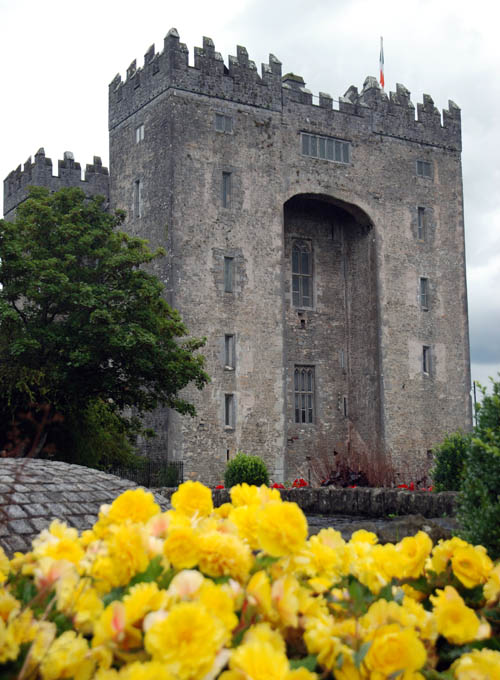
Bunratty castle
(in 14 Km.) Limerick: The city's major tourist attractions include King John's Castle (1212), St. Mary's Cathedral (1168), the Treaty Stone and the Hunt Museum. Our visit is reduced only to park next to the Treaty Stone, from which we see the King John's Castle on the other side of the river Shannon. The castle mainly conserves the exterior walls and the fortified towers, which have been adapted as a tourist attraction. During the process of building a visitor center, a Viking settlement was discovered in what is now the castle's courtyard.In its early years, the castle was surrounded by a moat, with a drawbridge that communicated with another main gate.
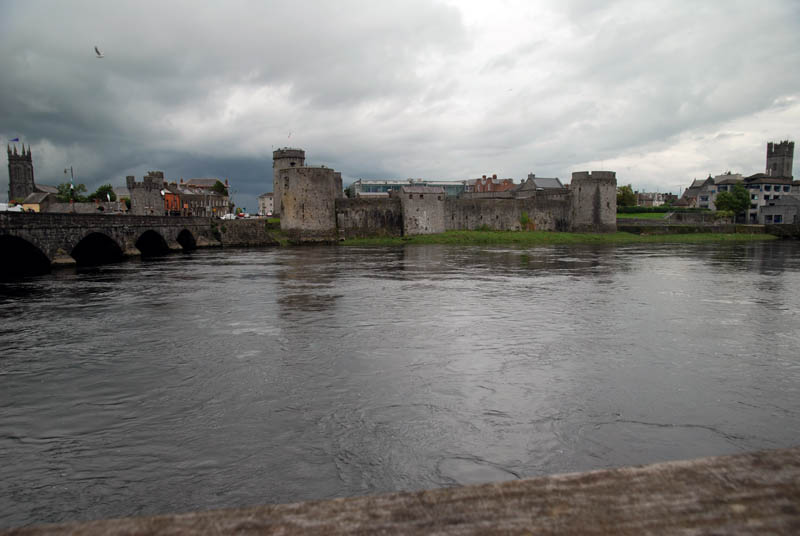
King John´s Castle
(in 20 Km.) Adare: Known as one of the most beautiful villages in Ireland, Adare is considered an Irish National Interest Heritage. The first point of tourist attraction is the Desmond Castle, built with an ancient ring-fort, around the first part of the 13th century. It was owned by the Counts of Kildare for almost 300 years until the rebellion in 1536, when it was confiscated and granted to the Counts of Desmond, who gave to the castle his current name. We get a nice view from the bridge of the N21 road over the Maigue river. A few meters away are the ruins of the Franciscan convent, founded in 1464, a characteristic example of the monasteries erected in Ireland during the fourteenth and fifteenth centuries. We enter the center of the town, where we find three other points of interest on the main street.

Adare - Desmond Castle
We find in the main street of Adare original country houses, with thatched roofs, which have survived for hundreds of years. Some of the houses are kept by local restaurants and art and craft stores, but many are still privately owned. Located next to the Adare Heritage Center, we find the only registered Trinitarian monastery in Ireland. The building was built by the FitzGerald dynasty for the Trinitarian Order in the 13th century. Repaired and expanded in the mid-19th century, the building is now called "Abbey of the Holy Trinity" and is used as the local Catholic Church. We finish the short visit to this village by taking a walk through Adare Town Park.

Adare
(in 85 Km.) Blennerville: We arrive at the accommodation, located just a few meters from the Blennerville windmill, where we will spend three nights and from which we will make the excursions to the Dingle peninsula and the Ring of Kerry. For dinner we enjoy Irish/Asian food from The Station House restaurant. We liked it so much, we repeated the following nights.