Travel to Jordan
Day 2 Amman - Jerash - Ajloun - Amman (143 Km.)
(50 km. away) Jerash: The ancient city of Gerasa, known today as Jerash, is one of the best-preserved archaeological sites of the Roman world outside Italy. Founded by Alexander the Great in the 4th century BC, Jerash prospered under Roman rule, becoming a thriving and culturally rich city. Its strategic location in the Decapolis region facilitated its growth as an important commercial and military centre. Today, the ruins of Jerash offer a fascinating window into ancient urban life, with its paved streets, squares, temples and theatres that have remained surprisingly intact. We begin our visit at the imposing Hadrian's Arch, erected in 129 AD to commemorate the visit of Emperor Hadrian. This monumental structure, 13 metres high, gives a majestic welcome to visitors.

Jerash - Arch of Hadrian
Passing through the arch, we head to the hippodrome, a vast arena that once hosted exciting chariot races and sporting events. With seating for 15,000 spectators, the hippodrome is a testament to the love of entertainment in ancient Gerasa. Continuing the tour, we arrive at the impressive Oval Forum, one of Gerasa's most distinctive monuments. This large square measuring 90 by 80 metres, surrounded by 56 Ionic columns, served as the centre of the city's public and ceremonial life. The square, with its oval-shaped paved floor, connects directly to the Cardo Maximus, forming an open space that impressed both ancient inhabitants and modern visitors.

Jerash - Oval Forum
Continuing the visit, we come across the imposing Temple of Zeus, a majestic building built in the 2nd century AD, on the hill to the left. This temple reflects the religious and cultural importance of Gerasa in Roman times. The temple offers panoramic views of the city and the surrounding natural environment, accentuating its magnificence. Visitors can admire the remains of its grandiose staircase and the imposing Corinthian columns that still stand, evoking the grandeur of the ceremonies held in honour of Zeus. Next to it is the southern theatre, one of the architectural jewels of Gerasa. Also built in the 2nd century AD, this theatre could seat over 3,000 spectators and is remarkable for its excellent state of preservation. Visitors can explore its stone tiers, ornate stage and impeccable acoustics. We proceed along the Cardo Maximus, the main street of Gerasa, paved with large stone slabs and flanked by Corinthian columns.

Jerash - South Theatre
Along the way, we find the nymphaeum, an elegant public fountain adorned with niches and statues that provided water to the city. Further on, the Cathedral and the Church of St Theodore, dating from the 5th century, show Gerasa's transition to a Christian city, with its impressive Byzantine architecture and mosaics. The Tetrapylon marks the intersection of Gerasa's main streets, with its square structure and columns that once held statues. Finally, we come to the Temple of Artemis, dedicated to the patron goddess of Gerasa. This temple, with its eleven imposing Corinthian columns, is one of the most impressive in the city. We end our tour of the ancient city of Gerasa at the North Theatre, a structure that, although smaller than its southern counterpart, is equally fascinating and revealing. Built at the end of the 2nd century AD, the North Theatre could seat some 1,600 spectators and was designed with an elegance and architectural precision that still astounds modern visitors. Its semi-circular structure and stepped stone tiers provide an excellent example of Roman engineering.

Jerash - Cardo maximus
(20 km. away) Ajloun: Due to its proximity to Gerasa, many include this site on their route. Ajloun Castle, also known as Qal'at ar-Rabad, is a historic fortress located in northern Jordan. Built in the 12th century by the Ayyubids under Saladin, the castle played a crucial role in defending against the Crusades and protecting trade routes. Perched on a hill with panoramic views over the Jordan Valley, its architecture combines military robustness and Islamic elegance, with strategically designed towers, walls and passageways. In addition to its historical and military significance, the castle offers a fascinating insight into medieval Islamic engineering.
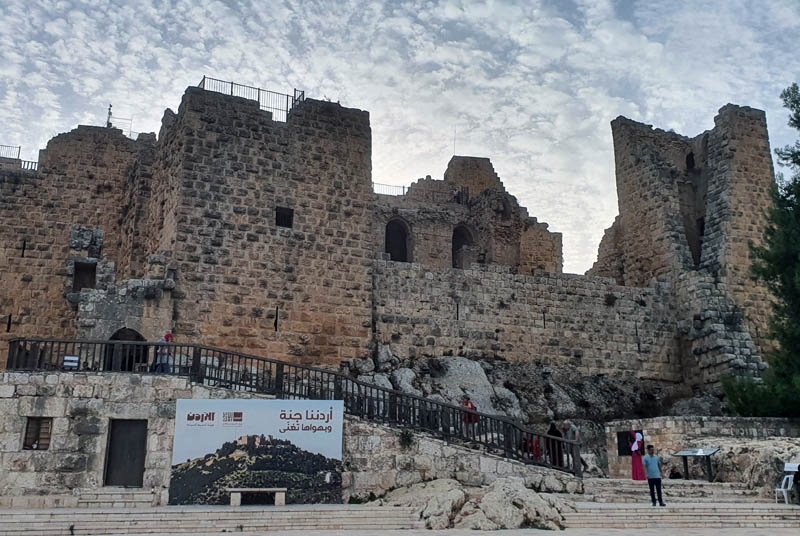
Ajloun Castle
(73 km. away) Amman: Amman's nightlife is vibrant and diverse, offering a mix of modernity and tradition that attracts locals and tourists alike. The streets of the centre, especially in areas such as Prince Muhammad and K. Faysal Square, come alive with cafes, bars and shops open late, creating a lively and cosmopolitan atmosphere. Visitors can enjoy live music, art galleries and a wide variety of international cuisines in the restaurants.
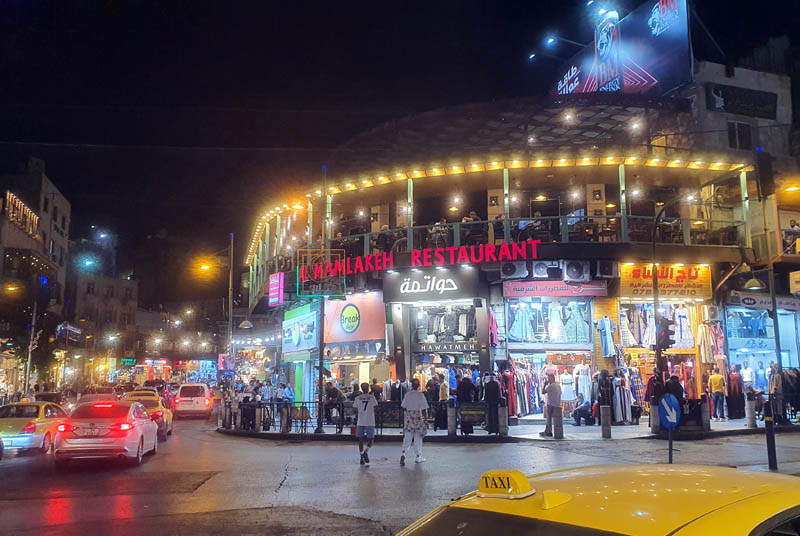
Amman by night
Strolling through these illuminated streets offers an enchanting experience, with the hustle and bustle of the city and warm Jordanian hospitality around every corner. We dined at the Zorba restaurant, which specialises in fish, where we savoured delicious fresh dishes.