Travel to Jordan
Day 5 Wadi Musa - Little Petra - Petra - Wadi Musa
In order to optimise our two-day visit to Little Petra and Petra, our approach was as follows: start with Little Petra and then go to Petra. Doing it the other way around could mean that Little Petra would be too small. To start in Little Petra and end in Petra, our recommendation is as follows: leave your car in the Petra car park and take the free shuttle from the visitor centre to Little Petra. After visiting Little Petra, take one of the four-wheel-drive vehicles to the back gate of Petra, starting at the Monastery and going down to the main entrance at the gates of the Siq. With this strategy, you do the tour in one direction only and avoid having to climb the 800 steps leading up to the monastery (you only go down the steps).
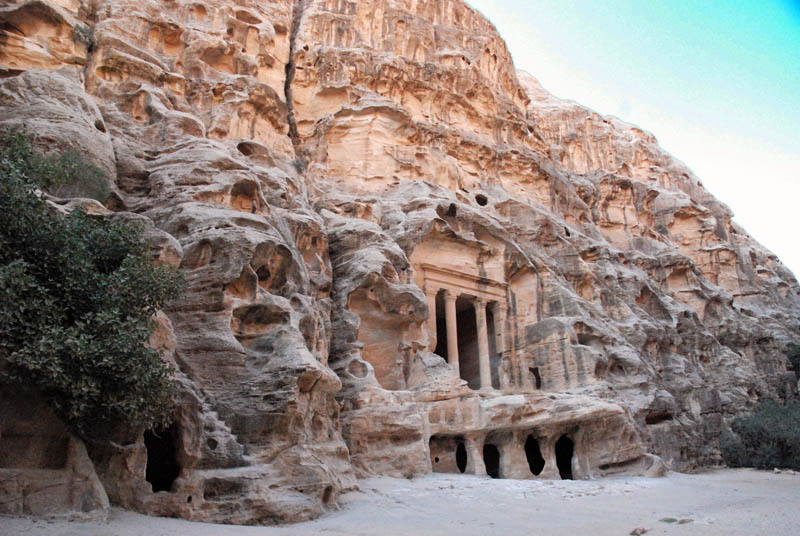
Litle Petra - Triclinium (Dushara temple)
(9 km. away) Little Petra: Little Petra, known as Siq al-Barid, is a small Nabataean city which, like its famous neighbour Petra, was abandoned after several earthquakes in the 7th century. For centuries, both cities remained forgotten and known only to local Bedouins, while in the West they remained legends. It was rediscovered in 1812 by the Swiss explorer Johann Ludwig Burckhardt, although Little Petra was not rediscovered until the late 1950s by the English archaeologist Diana Kirkbride. This discovery revealed a site used as a resting and resupply point for trading caravans en route to Petra. This archaeological site, less crowded than its famous neighbour, offers an intimate glimpse into the daily life of the Nabataeans, with its rock-cut structures dating from the 1st century BC.
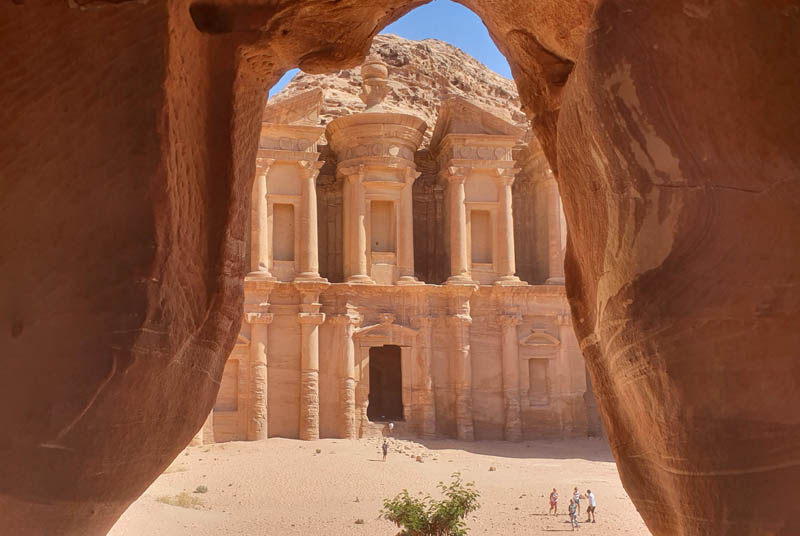
Petra - The Monastery (Ad Deir) from the cave
The visit to Little Petra begins by passing Bedouin stalls selling souvenirs and local produce. Without paying an entrance fee, we enter the narrow gorge of Siq al-Barid, where the first sight is the impressive Tomb Façade No. 846, flanked by pillars and columns decorated with Greco-Roman elements. Moving forward, we find rock-hewn dwellings and a carved cistern that collected rainwater. The main square is dominated by the Temple of Dushara, with four columns and underground chambers for rituals. Further on, we discover the Three Tricliniums and the Great Triclinium, used for ritual banquets and meetings. The Painted House, with its 2,000-year-old Nabataean fresco, and the final viewing platform with panoramic views of the valley complete this fascinating exploration.
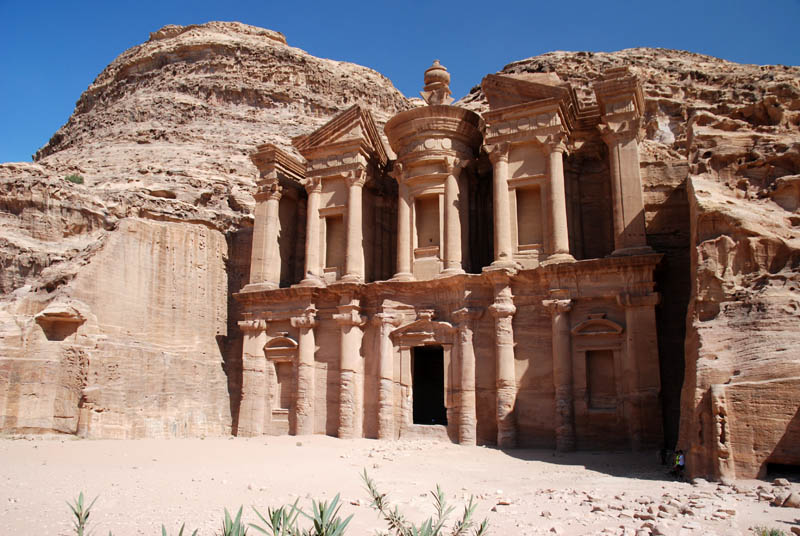
Petra - The Monastery (Ad Deir)
Petra, the jewel of Jordan, was founded in the late 8th century BC by the Edomites. Petra was occupied in the 6th century BC by the Nabataeans, who made it prosper due to its strategic location on the incense and spice caravan routes. By the 6th century AD, changes in trade routes and several earthquakes led to its abandonment. Rediscovered in 1812 by the Swiss explorer Jean Louis Burckhardt, Petra is famous for its rock-hewn façades and has been inscribed on the UNESCO World Heritage List since 1985. In addition, the surrounding area has been a national archaeological park since 1993 and Petra was recognised as one of the New Seven Wonders of the Modern World on 7 July 2007.
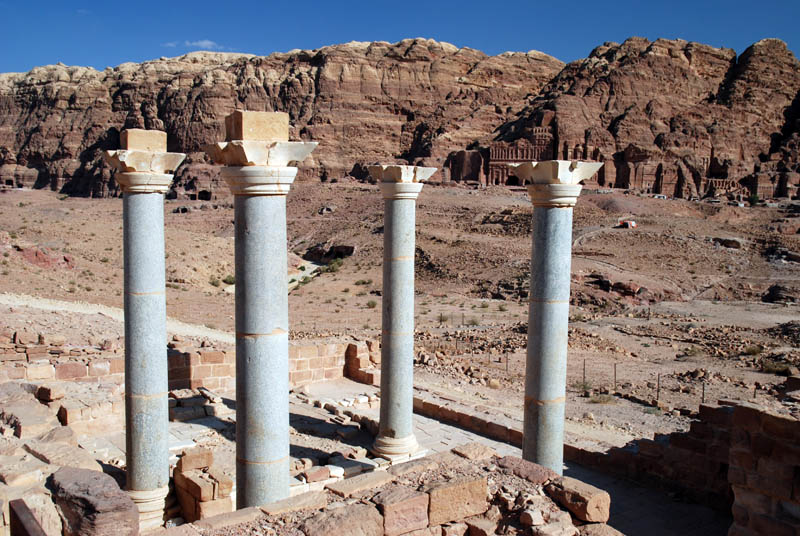
Petra - Blue Church
From Little Petra, many visitors opt to take the back entrance to Petra, a less-travelled route that offers a spectacular trekking experience. This trail passes through breathtaking mountain scenery and provides panoramic views of the surrounding desert. The back entrance leads directly to the Monastery, avoiding the crowds and providing a majestic arrival at one of Petra's most imposing monuments, offering a unique and exciting perspective of the ancient Nabataean city. Among other things, the monastery is the furthest point from the main entrance to Petra, so when you enter through the back gate most visitors will not yet have reached this point. The other main advantage is that you are spared the 800+ steps from the other entrance. On this side there are slightly less than half as many steps and the walk is much more bearable.
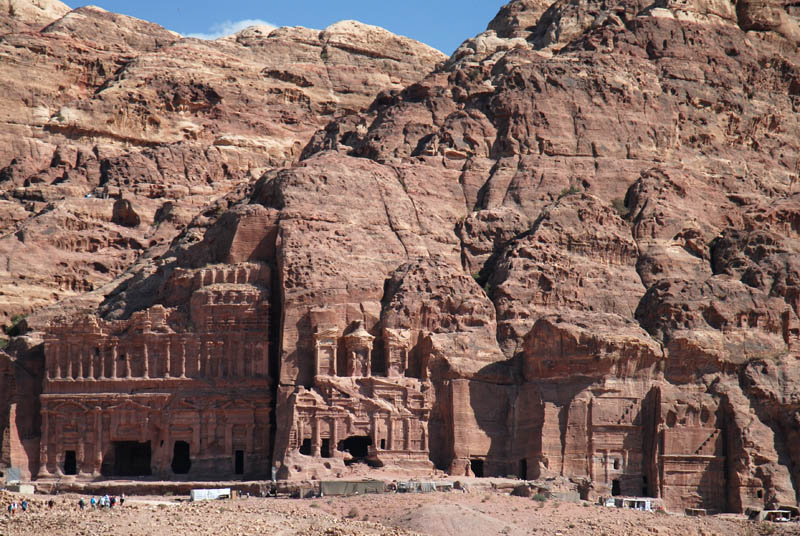
Petra - Facades street
The Monastery, known as Ad-Deir, is one of the most impressive monuments in Petra, second only to the Treasury in terms of magnificence. Built by the Nabataeans in the 1st century AD, it is almost 50 metres wide and approximately 45 metres high. It is a perfect example of the classical Nabataean style, with a façade carved and sculpted into the stone, reminiscent of that of the Treasury. However, unlike the Treasury, which is believed to have been a mausoleum, the Monastery was a place of worship built in honour of Obodas I, the king of the Nabataeans, deified after his death. Although there are no established viewpoints, there are many points from which you can get different perspectives of the temple. The most famous photo for instagramers is taken from the cave in front of the monastery.
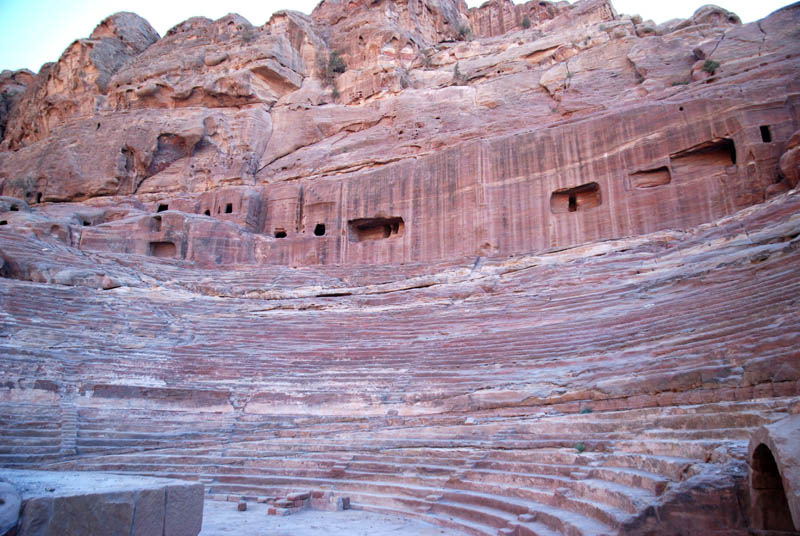
Petra - The Theatre
After descending the famous 800 steps, we arrive at an esplanade where we find a number of interesting sights. These include the Nymphaeum, an ornate public fountain, and the Street of Columns, Petra's main shopping street. Along this avenue are the Great Temple and the Gate of Temenos, leading to Qasr al-Bint, a Nabataean temple built in the 1st century AD, which was one of the most important temples in Petra, probably dedicated to Dushara and al-'Uzza. Nearby are the Temple of the Winged Lions, the 5th-century AD Byzantine Church, where a shelter protects its mosaics and frescoes from the weather, and the Blue Church, notable for its four blue-grey granite columns with Nabataean capitals.
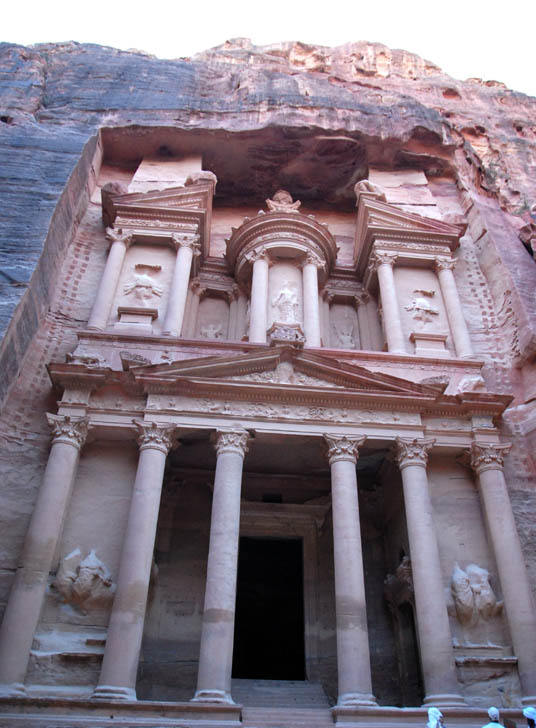
Petra - Treasury (Al-Khazneh)
On the way out, we see the Petra Theatre, originally built by the Nabataeans in the 1st century AD, with an initial capacity of 3,000 spectators. In 106 AD, the Romans expanded the theatre, increasing its capacity to 8,500. Carved mostly into the rock, the proscenium section was built with a combination of carved rock and masonry. The theatre has a semi-circular orchestra and tiers arranged in three superimposed levels in the shape of a crescent moon. Discovered in 1961 by a team of American archaeologists, the theatre is an impressive testimony to Roman architecture and adaptation in Petra. We close the day tour with the Treasury and the Siq, which we will visit again in the evening and the following day.
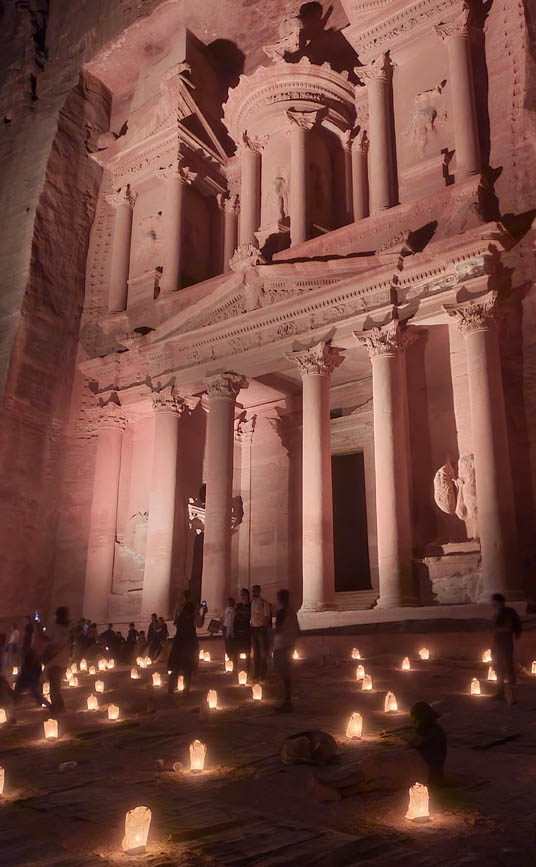
Petra by night - Petra night show
Our first day in Petra culminated in the ‘Petra by Night’ show, a night-time experience that allows visitors to see the Treasury illuminated by thousands of candles. This event takes place several nights a week and offers an enchanting, almost mystical atmosphere. Walking along the Siq under the starry sky, visitors are guided by the soft glow of candlelight to the Treasury, where traditional Bedouin music fills the air as you are invited for a cup of tea. It is a unique opportunity to see Petra from a different perspective, enveloped in an atmosphere of serenity and mystery. Many will probably find the price too expensive for the spectacle itself, but it's still worth seeing.