Travel to Tuscany
Day 8 Siena - Florence - Monteriggioni - Siena (160 Km.)
(in 78 Km.) Florence: We visited Florence for the second time. This time our main focus of interest was the Duomo, but first we passed Santa Maria Novella. Santa Maria Novella is one of the most important Gothic churches in Tuscany and is famous for its stunning frescoes, intricate architecture, and important role in the development of Renaissance art. The church was founded in the 13th century by the Dominican friars. The church was named after the nearby monastic complex of Santa Maria delle Vigne, which had been destroyed during a flood. It was designed by Fra Sisto Fiorentino, and construction began in the mid-13th century.
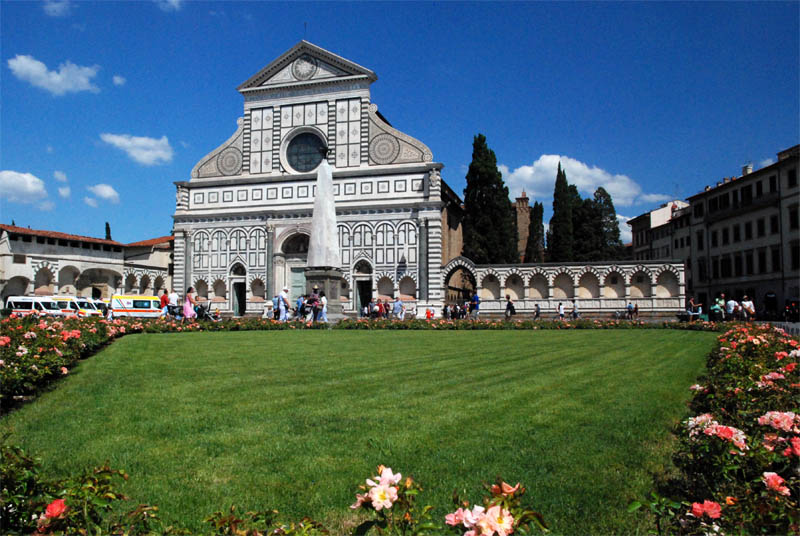
Florence - Santa Maria Novella
Over the next few centuries, many famous artists contributed to the decoration of the church, including Giotto, Masaccio, Brunelleschi, and Vasari. The church's façade is one of the most striking features of the building, with its elaborate marble decoration and Gothic arches. Inside, you can see the famous frescoes by Masaccio, including the "Trinity" and the "Expulsion from Paradise," which are considered some of the most important works of early Renaissance art. Other notable features of the church include the Cappella Tornabuoni, which is decorated with frescoes by Ghirlandaio, and the Cappella Strozzi, which features works by Filippo Lippi.
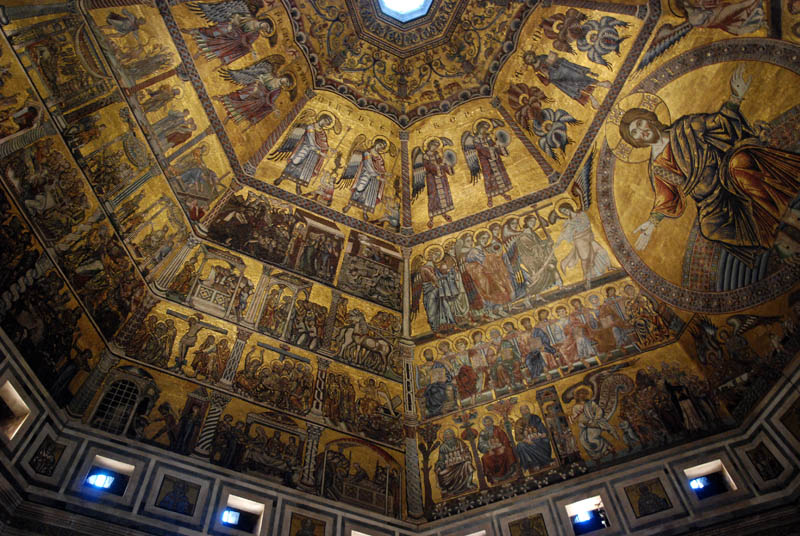
Florence - Baptistery of Saint John
Once we reached the Piazza del Duomo we started visiting The Baptistery of Saint John, one of the oldest monuments in the city. The Baptistery was built in the 11th century in the Romanesque style, and its exterior is covered with white and green marble in geometric patterns, which is characteristic of Tuscan architecture. The building is famous for its three sets of bronze doors, which are considered to be some of the most important masterpieces of medieval art. The most famous set of doors, known as the "Gates of Paradise," were created by the Italian sculptor Lorenzo Ghiberti and were installed in 1452. The doors depict scenes from the Old Testament, and their intricate details and lifelike figures are considered to be some of the finest examples of Renaissance art. The interior of the Baptistery has a magnificent dome and beautiful mosaics that cover the walls and ceiling. The mosaics were created over a period of several centuries, with the earliest dating back to the 13th century. They depict scenes from the Bible and the life of St. John the Baptist. The Baptistery was the site of important religious and civic ceremonies in Florence, such as the baptism of Dante Alighieri and the coronation of several Florentine rulers.

Florence - Duomo façade
The Duomo, or Cathedral of Santa Maria del Fiore, is renowned for its stunning Gothic architecture, and in particular, its elaborate façade. The façade of the Duomo was designed by the Italian architect, Emilio de Fabris, in the 19th century, after the cathedral had been standing without a completed façade for centuries. The façade is made of white, green, and pink marble, and is decorated with intricate details, including sculptures, reliefs, and colorful mosaic work. The lower level of the façade features large, ornate doors and an intricate series of marble reliefs, which depict various scenes from the Old Testament. Above the reliefs, there are three large, circular stained glass windows that bathe the interior of the cathedral in colorful light. The upper level of the façade is dominated by a towering central rose window, which is surrounded by sculptures of prophets and other religious figures. The central portal of the façade is framed by two towering marble pillars, which are adorned with sculptures of saints and angels. Above the portal, there is a series of sculptures that depict the Madonna and Child, as well as various saints and prophets. The top of the façade is crowned by a series of ornate sculptures, including a statue of Saint John the Baptist, the patron saint of Florence.
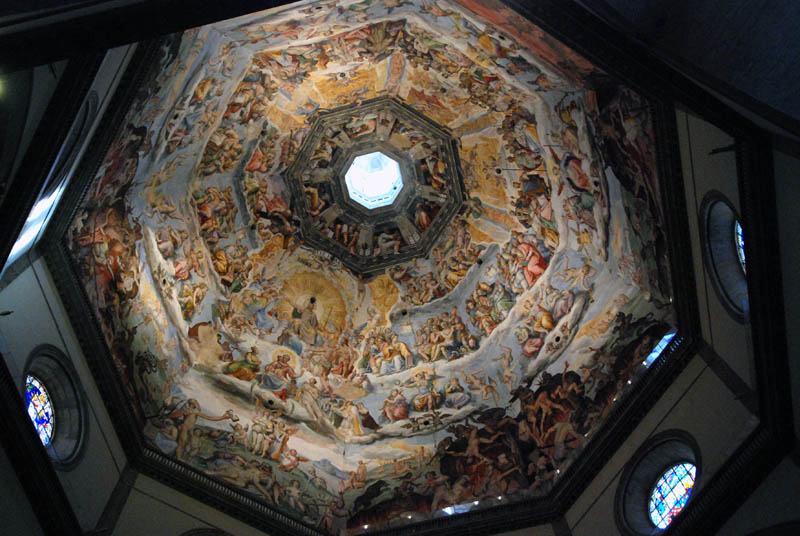
Florence - Dome of Cattedrale di Santa Maria del Fiore
The interior of the Duomo is just as awe-inspiring as its exterior. The central nave of the cathedral is a vast space, stretching over 150 meters in length and 38 meters in width. It is lined with marble pillars, which support the vaulted ceiling, and the floor is made of intricately patterned marble tiles. One of the most striking features of the interior is the cupola, or dome, which spans the entire central nave. The dome was designed by Filippo Brunelleschi in the 15th century and is considered a masterpiece of Renaissance engineering. The walls of the cathedral are covered in a series of intricate frescoes, which depict scenes from the life of Christ, as well as other religious figures and events. Some of the most famous frescoes were created by Italian Renaissance artists like Giorgio Vasari and Andrea del Castagno. The cathedral's windows are another notable feature of the interior. The stained glass windows in the nave and transept are particularly striking, with their bold, colorful designs. At the far end of the nave is the high altar, which is surrounded by a choir and apse. The altar is adorned with a series of ornate sculptures and reliefs, while the choir stalls are decorated with intricate carvings and inlaid woodwork.
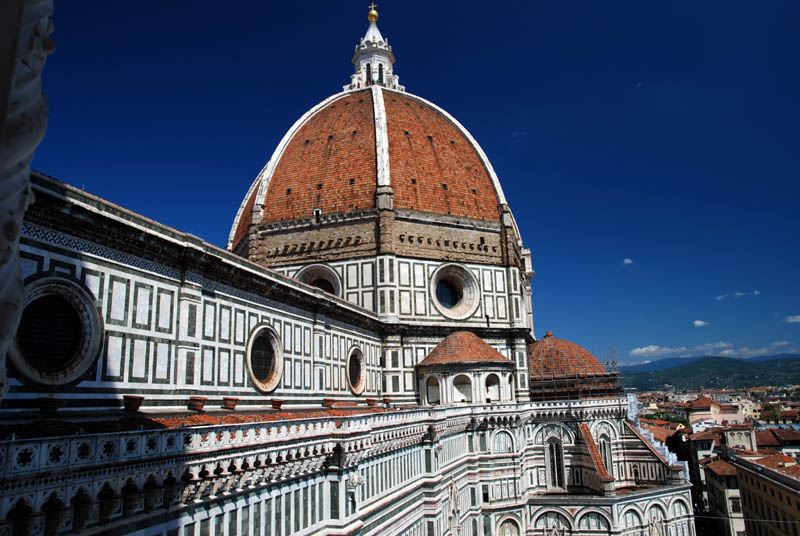
Florence - Duomo dome
The dome of the Cathedral is one of the largest ones in the world. It's 45.5 meters (149 feet) in diameter and stands 114.5 meters (376 feet) tall from the ground. It is a double shell dome, with an inner and outer layer of brick, and has an octagonal shape. Brunelleschi's innovative construction technique involved using interlocking brick ribs to create the dome's structure. The ribs were designed to support the weight of the dome without the need for a wooden centering framework, which would have been difficult to build at such a great height. The interior of the dome is decorated with a series of intricate frescoes, painted by Italian Renaissance artists like Giorgio Vasari and Federico Zuccari and depict scenes from the life of Saint John. At the top of the dome is a lantern, which is surrounded by a viewing gallery. Visitors can climb a narrow staircase to the top of the lantern for breathtaking views of Florence and the surrounding countryside. The dome remains one of the most impressive and iconic features of Florence's skyline.

Florence - Palazzo Vecchio from Campanile di Giotto
The Campanile di Giotto, also known as Giotto's Bell Tower, is a freestanding bell tower located next to the Duomo. It was designed by the Italian artist Giotto di Bondone in the 14th century and completed after his death. The bell tower is 84.7 meters (277.9 feet) tall and is made of marble, with different colors and patterns creating decorative bands around the tower. The base of the tower is square, while the upper part is octagonal, and it is divided into five levels, each with a different design and decoration. On the first level, there are four niches with statues of the four evangelists, while the second level features 14 reliefs depicting scenes from the Old Testament. The third level has 14 reliefs that depict scenes from the life of Jesus Christ, and the fourth level features 14 reliefs representing virtues and vices. The fifth and final level is where the bell chamber is located, which houses seven bells that chime on special occasions. The bells are named after saints and weigh a total of about 36,000 kilograms.

Monteriggioni
(in 62 Km.) Monteriggioni: Monteriggioni is a small medieval walled town situated on a hilltop. It is known for its well-preserved fortifications and charming medieval architecture. Monteriggioni was built in the 13th century as a defensive fortress to protect the city of Siena from its rival Florence. The town is surrounded by walls that are over 500 meters long and 14 meters high, with 14 towers along the perimeter. Inside the walls, Monteriggioni has a compact and picturesque historic center, with narrow streets and stone buildings. The town's main square, Piazza Roma, is home to a small church, a few cafes and restaurants. There are some small museums, including a weapons museum and a medieval art museum. Monteriggioni has been featured in several works of literature and art, including Dante's "Divine Comedy".
(in 20 Km.) Siena: We return to our accommodation.