Travel to Tuscany
Day 2 Cannes - Pisa - Lucca (412 Km.)
(in 392 Km.) Pisa: Although Pisa is known worldwide for its leaning tower (the bell tower of the city's cathedral), the city contains more than 20 other historic churches, several medieval palaces, and various bridges across the Arno. Much of the city's architecture was financed from its history as one of the Italian maritime republics. "The leaning Tower of Pisa" is one of many works of art and architecture in the city's Piazza del Duomo, also known, since the 20th century, as Piazza dei Miracoli (Square of Miracles), to the north of the old town center. The Piazza del Duomo also houses the Duomo (the Cathedral), the Baptistry and the Campo Santo (the monumental cemetery). The medieval complex includes the above-mentioned four sacred buildings, the hospital and few palaces.
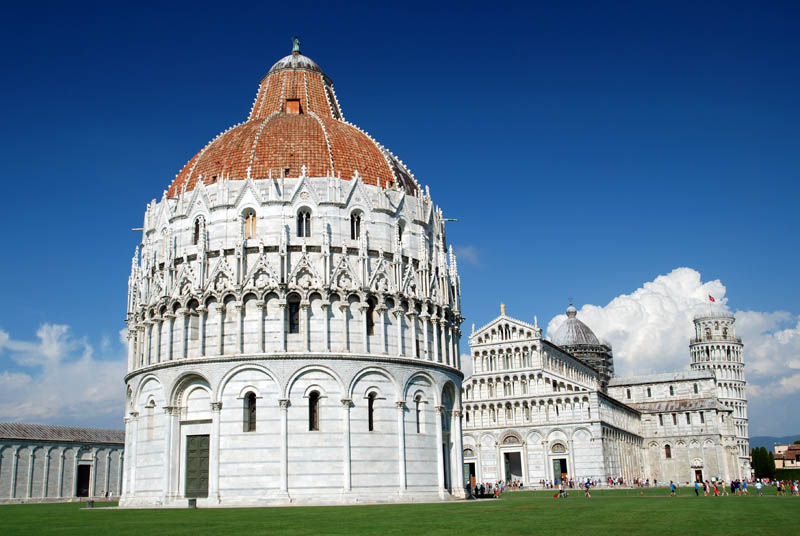
Pisa - Piazza dei Miracoli
The Leaning Tower of Pisa or simply the Tower of Pisa is the campanile, or freestanding bell tower, of the cathedral of Pisa, known worldwide for its nearly four-degree lean, the result of an unstable foundation. The tower began to lean during construction in the 12th century, due to soft ground which could not properly support the structure's weight, and it worsened through the completion of construction in the 14th century. Construction of the tower occurred in three stages over 199 years. Work on the ground floor of the white marble campanile began on 14 August of 1172 during a period of military success and prosperity. The tower began to sink after construction had progressed to the second floor in 1178. Construction was subsequently halted for almost a century. In an effort to compensate for the tilt, the engineers built upper floors with one side taller than the other. Because of this, the tower is curved. The seventh floor was completed in 1319. The bell-chamber was finally added in 1372.

Leaning Tower of Pisa
While we wait for the assigned time to visit the Duomo, we go to Piazza dei Cavalieri (Knights’ Square).The main building on the square is Palazzo della Carovana, the palace of the Knights of St. Stephen, and formerly the Palace of the Elders. It was modernised in Renaissance style by Giorgio Vasari. The façade is decorated with sgraffiti, equally by Vasari, and contains six niches with busts of grand dukes of Tuscany. In front of the palace stands the large statue of Cosimo I de Medici by Pietro Francavilla, who also designed the Palace of the Priors in 1603. In the other corner of the square stands the Palazzo dell'Orologio, which is referred to in Dante's Inferno.
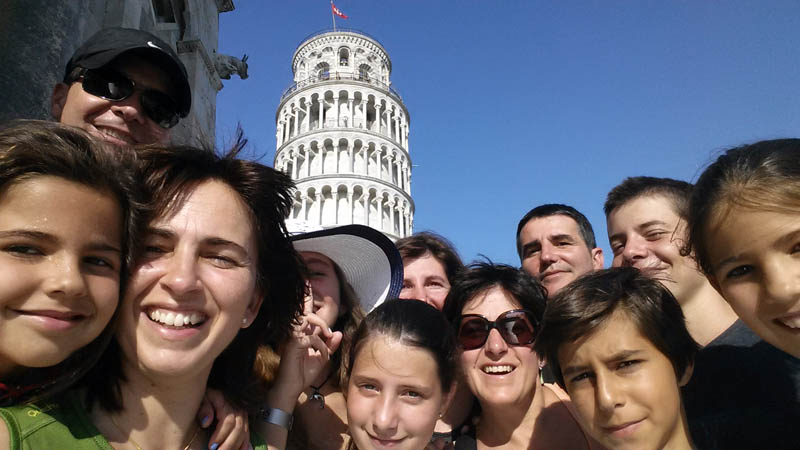
Pisa - Selfie
We come back to the The Piazza dei Miracoli, In 1987, the whole square was declared a UNESCO World Heritage Site. The construction of the Pisa Baptistery of St. John started in 1152 to replace an older baptistery, and it was completed in 1363. The largest baptistery in Italy, it is 54.86 m high, with a diameter of 34.13 m. The Pisa Baptistery is an example of the transition from the Romanesque style to the Gothic style: the lower section is in the Romanesque style, with rounded arches, while the upper sections are in the Gothic style, with pointed arches. The Baptistery is constructed of marble. The portal, facing the facade of the cathedral, is flanked by two classical columns, while the inner jambs are executed in Byzantine style. The pulpit was sculpted between 1255-1260 by Nicola Pisano, father of Giovanni, the artist who produced the pulpit in the Duomo.
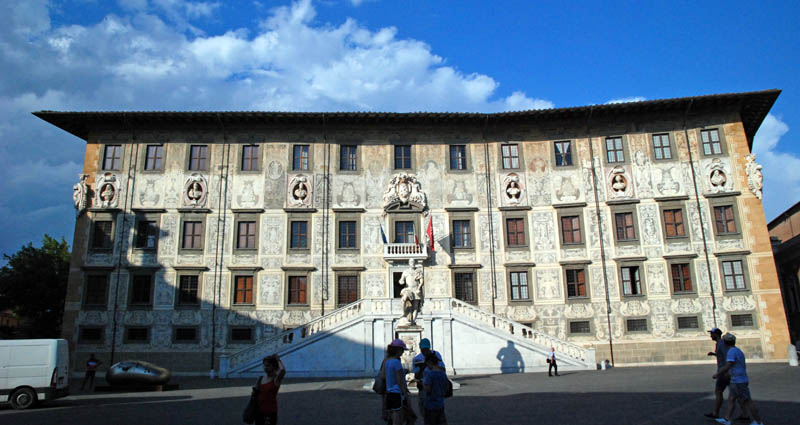
Pisa - Piazza dei Cavalieri
The construction of the Pisa cathedral began in 1063. The original building plan was a Greek cross with a grand cupola at the crossing, but today the plan is a Latin cross with a central nave flanked by two side aisles on each side, with the apse and transepts having three naves. The rich exterior decoration contains multicolored marble, mosaic, and numerous bronze objects from the spoils of war, among which is the griffin which was taken in Palermo in 1061 and later placed on the eastern part of the roof. The heavy bronze doors of the facade were made by different Florentine artists in the 17th century. The interior, subdivided at the front into a central nave flanked by two side aisles on either side and with the transept and apse in three naves, is covered with white and black marble, with monolithic grey marble columns having corinthian capitals. It has a wooden 17th-century coffered ceiling, painted and decorated with gold leaf. For these qualities united to the skillful narrative art of the nine scenes the pulpit is generally considered to be a masterpiece, but more broadly it is considered a masterpiece of Italian gothic sculpture.
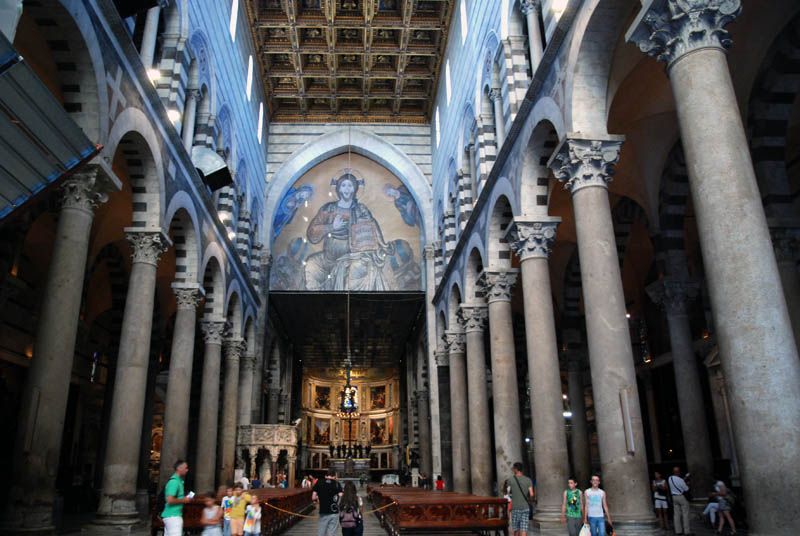
Pisa Cathedral
The Campo Santo is also known as Camposanto Monumentale ("monumental cemetery"). The construction of this huge, oblong Gothic cloister was begun in 1278 by the architect Giovanni di Simone, and completed in 1464.The outer wall is composed of 43 blind arches. The inner court is surrounded by elaborate round arches with slender mullions and plurilobed tracery. The Campo Santo contained a huge collection of Roman sarcophagi. The walls of the vast structure were covered in over 2600 meters squared of frescoes, a greater expanse than the Sistine Chapel.
(in 20 Km.) Lucca: We move to our accommodation for the next few days located in Carignano, on the outskirts of Lucca.