Travel to Tuscany
Day 3 Lucca (0 Km.)
Lucca: Birthplace of composer Giacomo Puccini, Lucca is famous for its intact Renaissance-era city walls.The walls encircling the old town remain intact, even as the city expanded and modernized, unusual for cities in the region. Initially built as a defensive rampart, once the walls lost their military importance they became a pedestrian promenade, the Passeggiata delle Mura Urbane, a street atop the walls linking the bastions. We entered the old town through the San Frediano bastion. From the top of this point we saw the gardens of the Palazzo Pfanner, a palace built in 1667, notable mainly for its fine garden, attributed to Filippo Juvarra, and an interesting external stairway with loggia.
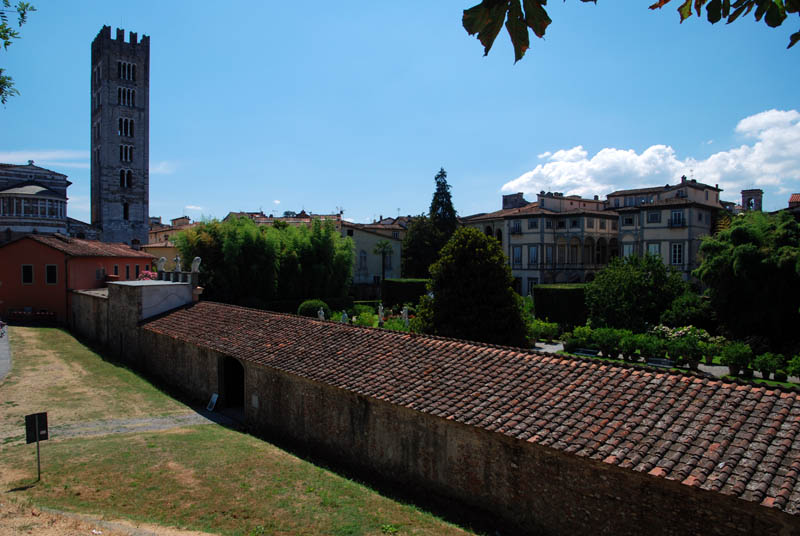
Lucca - Palazzo Pfanner gardens and Basilica di San Frediano
We continue towards the Piazza San Frediano, where stands up the Basilica of San Frediano, a Romanesque church that acquired its present appearance of a typical Roman basilica during the period 1112-1147. In the 13th-14th centuries the striking façade was decorated with a huge golden 13th century mosaic representing The Ascension of Christ the Saviour with the apostles below. Inside, the basilica is built in richly carved white marble. It consists of a nave and two aisles with arches supported by columns with Roman and Romanesque capitals. The Roman capitals were recycled from the nearby Roman amphitheatre. The highlight at the entrance is the huge 12th-century Romanesque baptismal font (the Fonte Lustrale).On the right hand is the side chapel of St. Zita (c. 1212-1272), a popular saint in Lucca. Her intact mummified body, lying on a bed of brocade, is on display in a glass shrine. The remains of St. Frediano lie underneath the main altar from the 16th century. Among the many chapels, the Chapel of the Cross certainly stands out. It contains frescoes, recently restored, by Amico Aspertini (1508-1509).
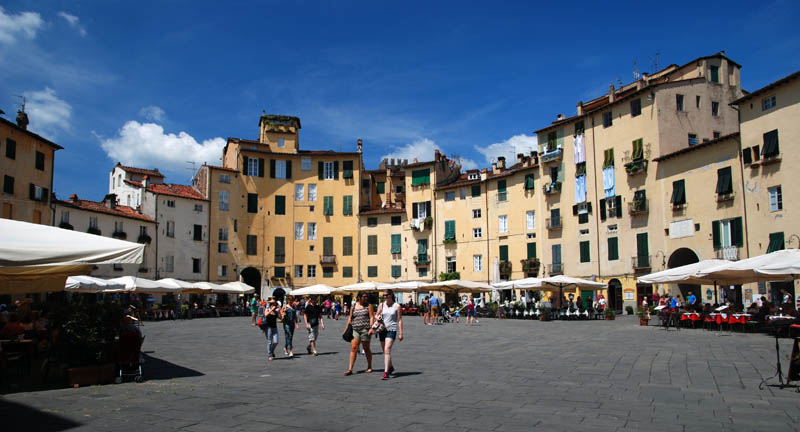
Lucca - Piazza dell´Anfiteatro
Piazza dell'Anfiteatro is a square in the northeast quadrant of walled center. The ring of buildings surrounding the square, follows the elliptical shape of the former second century Roman amphitheater of Lucca. The square can be reached through four gateways located at the four vertices of the ellipse. A cross is carved into the central tile of the square with the arms pointing to the four gateways of the square. After leaving this square, we continue along Via del Moro, until we reach Piazza San Michele. In the center of the square is the church of San Michele in Foro, Notable is the façade, from the 13th century, with a large series of sculptures and inlays, numerous of which remade in the 19th century. The lower part has a series of blind arcades, the central of which includes the main portal. The upper part, built using plenty of iron materials to counter wind, has four orders of small loggias. On the summit, flanked by two other angels, is the 4 m-tall statue of St. Michael the Archangel. From the southern transept rises the bell tower, built in the 12th-14th centuries, with a series of single, double and triple mullioned windows.
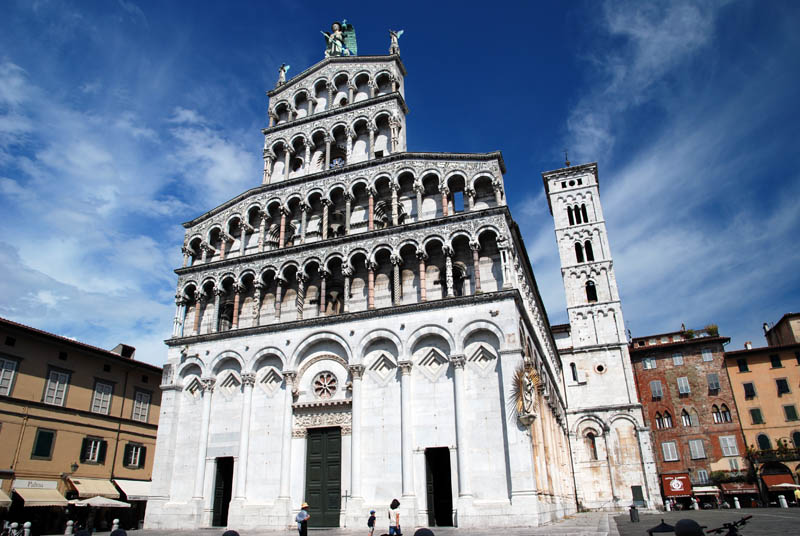
Lucca - San Michele in Foro
At Piazza Napoleone we find the Palazzo Ducale. It is located on the site of the Fortezza Augustan, the residence of condottiero Castruccio Castracani, where also was his palace. The large complex was destroyed by the populace in 1370. The fortress was restored and used as residence by Paolo Guinigi in 1401. The palace is of large size and owes its current appearance to Bartolomeo Ammannati's restoration in 1578. The palace includes a central court, which is unfinished. It has a double portico with pillars and, in the center, a statue of the Lucchese lawyer Francesco Carrara, work by Augusto Passaglia. On the left is another unfinished court, known as Cortile degli Svizzeri, referring to the corps of Swiss Guard in service of the Republic of Lucca. The interior hall is accessed through a monumental stair by Nottolini that ends with a gallery of statues. The Hall of the General Council of the Republic has a Flemish painting and a fresco of the Lucchese Freedom. Above the Loggia delle Guardie is the Ammannati Loggia, decorated with grotesques and stucco. Teatro del Giglio (Theater of the Giglio), located in Piazza del Giglio, is the historic city theater and opera house. It was inaugurated in 1675. The rusticated portico is surmounted by a balustrade upholding pilasters, that lead to a tympanum with the coat of arms of the city. A statue of Garibaldi stands in the square in front of the theater.
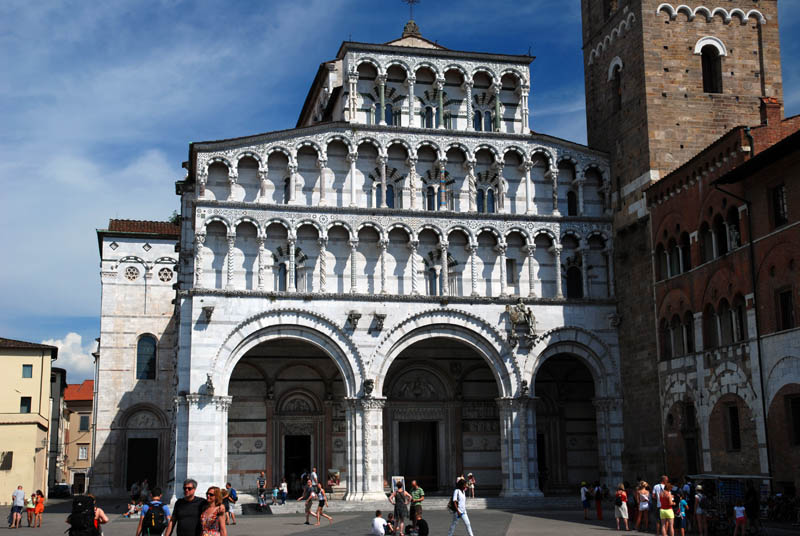
Lucca - Cathedral
A few meters later, after passing in front of the church of Santissimi Giovanni e Reparata, we reach Piazza San Martino, where the Lucca Cathedral or Duomo di San Martino is located. Construction was begun in 1063 by Bishop Anselm (later Pope Alexander II). Of the original structure, the great apse with its tall columnar arcades and the fine campanile remain. The nave and transepts of the cathedral were rebuilt in the Gothic style in the 14th century, while the west front was begun in 1204 by Guido Bigarelli of Como, and consists of a vast portico of three magnificent arches, and above them three ranges of open galleries adorned with sculptures. In the nave a small octagonal temple or chapel shrine contains the most precious relic in Lucca, the Holy Face of Lucca. This cedar-wood crucifix and image of Christ, according to the legend, was carved by his contemporary Nicodemus, and miraculously conveyed to Lucca in 782. Additionally the cathedral contains Domenico Ghirlandaio's Madonna and Child with Saints Peter, Clement, Paul and Sebastian; Federico Zuccari's Adoration of the Magi, Jacopo Tintoretto's Last Supper, and finally Fra Bartolomeo's Madonna and Child (1509).
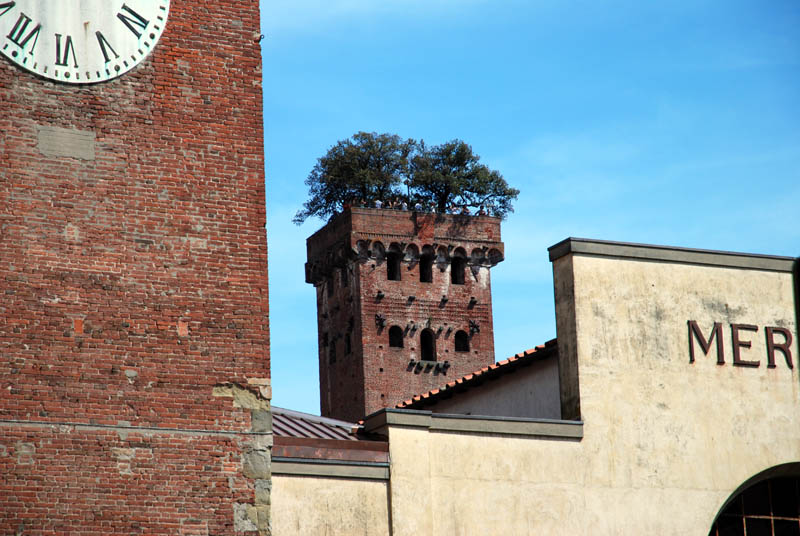
Lucca - Guinigi tower
The Guinigi tower is a typical example of local Romanesque-Gothic architecture. The height of the tower is 45 meters with a total of 232 steps to reach the top. The tower dates from the 1300s, when a number of wealthy families were building bell towers within the walls of Lucca as status symbols. It is one of the few remaining towers within the walls. It is known for the tall trees (holm oaks) growing on top of the tower - The kitchen was originally on the floor below with the rooftop serving as a kitchen garden. Medieval Lucca, like many medieval cities in Italy abounded with private towers, built for protection, exemplified best today by the remaining towers of San Gimignano. Torre delle Ore, the tallest in Lucca, was acquired by the government in the 14th century, and in 1390, it was decided to house a clock. The present mechanism of the clock dates to the 18th-century.
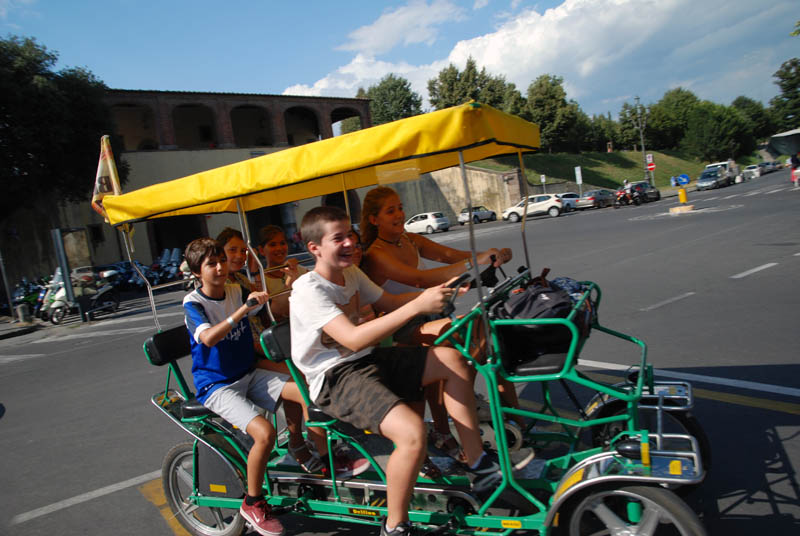
Lucca - Bike ride
We leave the old town strolling along Via Fillungo, the most important shopping street in Lucca. Once outside the walls, the children rented bicycles to walk the pedestrian promenade that runs above the wall, whose circumvallation has a total length of four and a half kilometers. We spend the last hour of the afternoon bathing in the hotel pool.