Travel to Croatia
Day 11 Pula – Rovinj – Poreč – Verona - Brescia (491 Km.)
Pula: Pula, the largest city in Istria, is a place where history comes alive. With its origins tracing back over 3,000 years, Pula was an important Roman colony known as Pietas Julia, flourishing under the rule of Emperor Augustus. The city later became part of the Byzantine, Venetian, and Austro-Hungarian empires, each leaving their mark on its architecture and culture. Due to its strategic location on the Adriatic, Pula was often a contested territory, but it has always retained its unique identity. Today, it is famous for its Roman ruins, Venetian influences, and vibrant coastal atmosphere, making it one of Croatia’s most fascinating destinations.
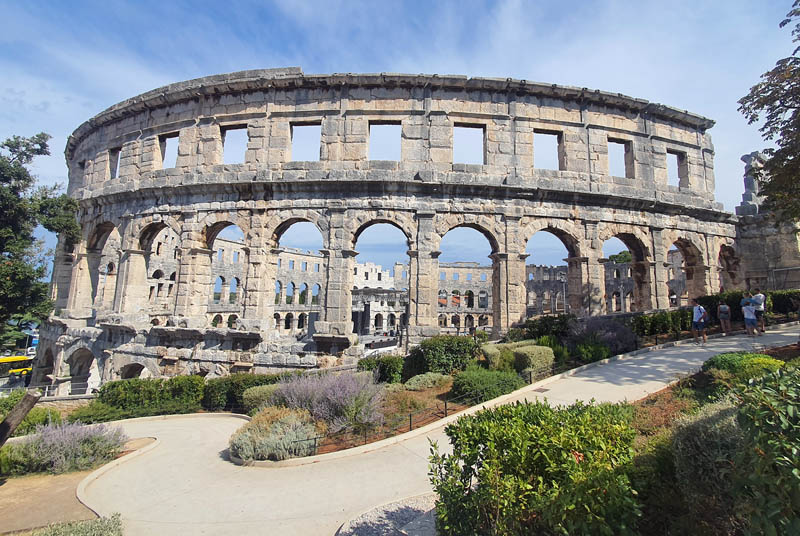
Pula Arena
Our visit to Pula began with one of its most iconic landmarks—the Pula Arena, a Roman amphitheater that dominates the cityscape. Built between 27 BC and 68 AD, during the reigns of Emperors Augustus and Vespasian, it is the sixth-largest surviving Roman amphitheater in the world and the best-preserved in Croatia. With a capacity of up to 23,000 spectators, this grand structure was originally used for gladiatorial contests, chariot races, and public spectacles. Unlike other amphitheaters that have suffered significant destruction over time, Pula Arena remarkably retains its entire outer wall, featuring 72 arches that once supported awnings to protect spectators from the sun. The amphitheater is elliptical in shape, measuring 132 meters in length and 105 meters in width, with an impressive three-tiered façade built using local limestone. Beneath the arena floor lies a well-preserved system of underground passages, which were once used to house animals, gladiators, and stage props before battles. The arena’s acoustic properties make it an ideal venue for modern performances, and today, it hosts concerts, film screenings, and even medieval reenactments, bringing ancient history to life in an unforgettable way. One of the most fascinating aspects of Pula Arena is how it has remained in continuous use for nearly 2,000 years. During the Middle Ages, it was repurposed for knightly tournaments and fairs, while in later centuries, it narrowly escaped destruction—Venetians once considered dismantling it to reuse its stone in Venice, but thankfully, the idea was abandoned.

Pula Arena
Leaving the amphitheater, we made our way through Pula’s historic gates. First, we passed through the Porta Gemina (Twin Gates), a well-preserved Roman entrance once part of the city’s defensive walls. Not far away stood the Gate of Hercules, the oldest Roman monument in Pula, dating back to the 1st century BC. We then arrived at the Arch of the Sergii, a beautifully decorated triumphal arch erected in honor of a noble Roman family. It marked the entrance to the ancient city and still serves as a grand welcome to visitors today. From there, we climbed to the Roman theater, located on a hill overlooking the city. Although smaller than the arena, it was once a lively venue for performances and gatherings, offering stunning panoramic views. Continuing our walk, we visited the Chapel of Santa Maria Formosa, one of the few remaining examples of Byzantine architecture in Croatia. This 6th-century chapel, originally part of a larger monastery, has a simple yet elegant design, with traces of its mosaic floors still visible.
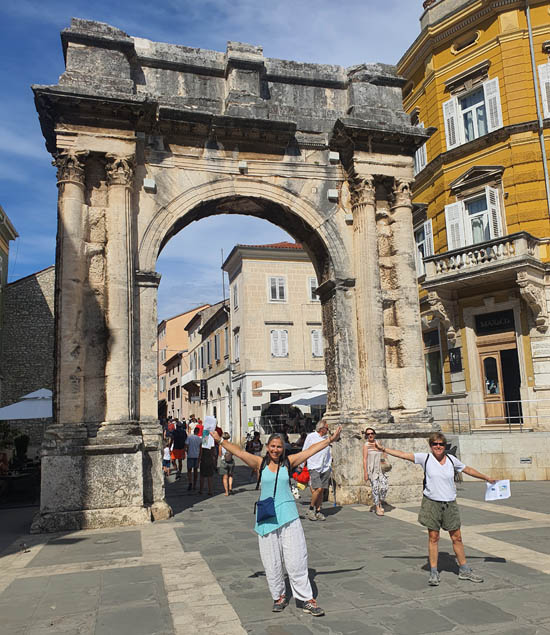
Pula - Arch of the Sergii
Continuing our walk through Pula’s historic center, we arrived at the Temple of Augustus, one of the best-preserved Roman temples outside of Italy. Located in the Forum, the city’s main square since ancient times, this elegant structure was built between 2 BC and 14 AD, during the reign of Emperor Augustus. It was originally part of a larger temple complex, which included a second temple dedicated to Diana, remnants of which are still visible on the adjacent Communal Palace. The Temple of Augustus was dedicated to the first Roman emperor and the goddess Roma, reflecting the empire’s influence over Pula at the time. Standing at 8 meters high and 17.65 meters long, the temple is a masterpiece of Roman architecture, constructed with local limestone and featuring a Corinthian portico with six fluted columns. Its pediment, though partially eroded, still showcases traces of decorative reliefs. Inside, the temple originally housed a statue of Augustus, which was likely worshipped by the citizens of Pietas Julia. Over the centuries, the temple endured multiple transformations: during the Byzantine era, it was converted into a church, and in the Middle Ages, it served as a granary.
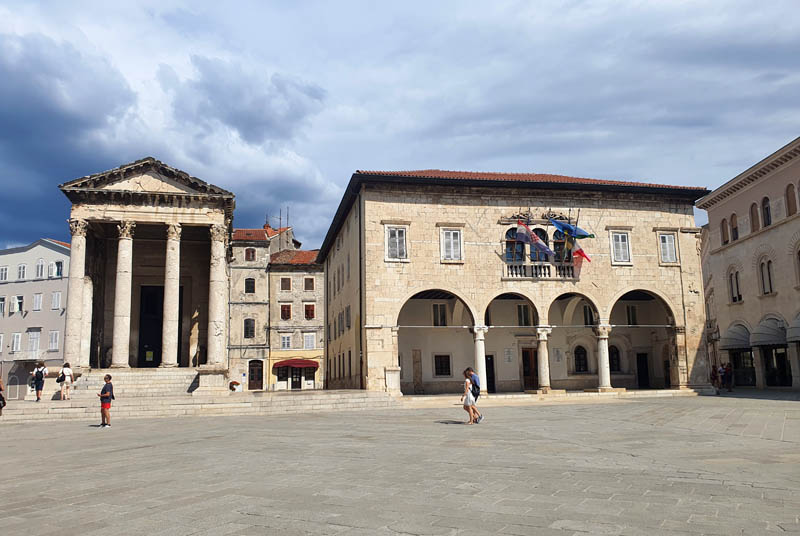
Pula - Temple of Augustus and Town Hall
Next to it, the Communal Palace, Pula’s historic town hall, showcases a mix of architectural styles from Roman, Gothic, and Renaissance periods, reflecting the city’s layered history. Our final stop was the Cathedral of the Assumption of the Blessed Virgin Mary, a site that has been a place of worship since the early Christian era. Built on the remains of a Roman temple, the cathedral features a mix of architectural styles, with its bell tower standing as a later Venetian addition. Inside, the stone columns and religious artwork tell the story of Pula’s spiritual past. As we wandered back through the lively streets, we couldn’t help but admire how Pula seamlessly blends its Roman heritage with its vibrant present. From ancient amphitheaters to charming squares, every corner of the city felt like a journey through time, making our visit an unforgettable experience.
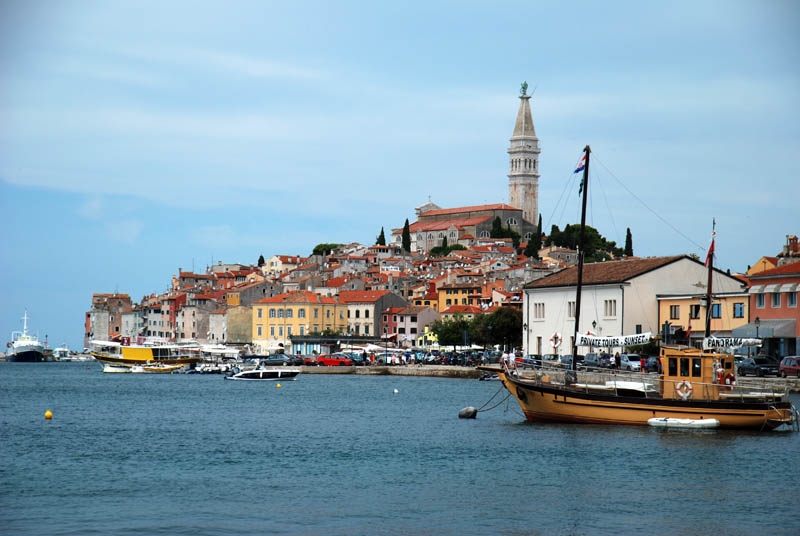
Rovinj
(in 43 Km.) Rovinj: Our visit to Rovinj, one of the most picturesque towns on the Istrian Peninsula, was unfortunately brief due to the overwhelming summer crowds. After circling the town multiple times in search of a parking spot without success, we ultimately decided to admire Rovinj’s charming skyline from the harbor, capturing a beautiful photo of its colorful houses stacked along the hillside, with the Church of St. Euphemia’s bell tower rising majestically above them. Though we didn’t get to explore the town on foot, we knew that Rovinj’s Old Town is a maze of cobbled streets, Venetian-style architecture, and art galleries. The Balbi Arch, the former entrance to the town, and Grisia Street, lined with artisan workshops, are among its most famous sights. Another highlight is the Church of St. Euphemia, an impressive Baroque church dedicated to Rovinj’s patron saint, whose sarcophagus is housed inside. The town’s waterfront promenade, with its charming cafés and restaurants, is the perfect place to soak in the lively atmosphere. Despite not being able to walk its streets, just catching a glimpse of Rovinj’s fairytale-like beauty left us eager to return another time, preferably during a quieter season.
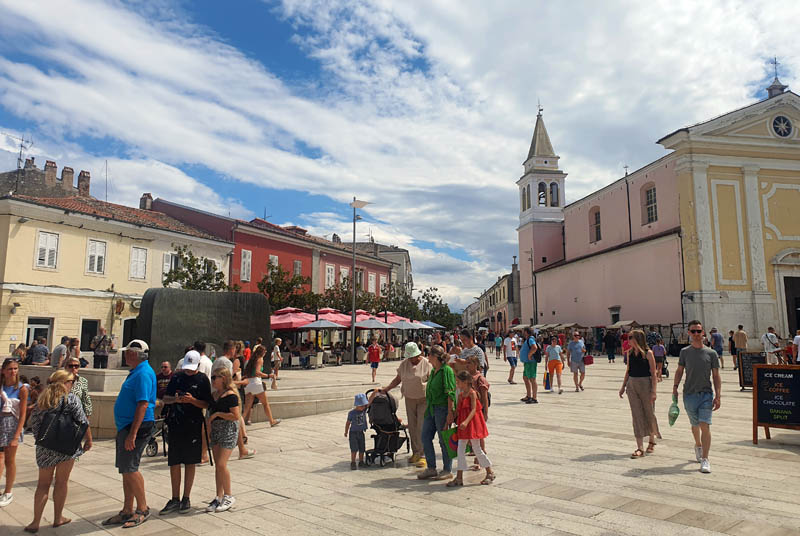
Poreč - Church of Our Lady of the Angels
(in 35 Km.) Poreč: Our next stop was Poreč, a charming coastal town on the Istrian Peninsula, where we decided to take a break and enjoy lunch before exploring its historical sites. We found several restaurants serving delicious Istrian specialties, and of course, truffle pasta, one of the region’s signature dishes. We began our visit at the Church of Our Lady of the Angels, a lovely Baroque church built in the 18th century. From there, we made our way to the Riva, the scenic promenade that runs along the northern part of the Old Town’s medieval walls, offering beautiful views of the sea and the nearby islands of St. Nicholas and St. Lucia. Continuing through the heart of the Old Town, we explored the Roman ruins, remnants of Poreč’s ancient past when it was an important settlement in the Roman Empire.
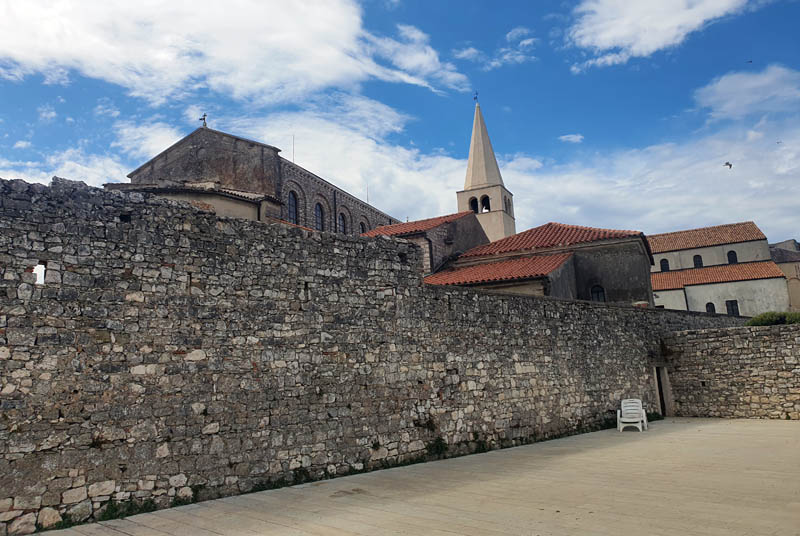
Poreč - City wall and Euphrasian Basilica
Walking along Ulica Decumanus, the town’s main street, we admired the well-preserved Venetian-style buildings, charming stone houses, and lively shops. Our final stop was the stunning Euphrasian Basilica, a UNESCO World Heritage Site and one of the best-preserved early Christian complexes in Europe. Built in the 6th century, it features breathtaking Byzantine mosaics depicting biblical scenes in shimmering gold and vibrant colors. The basilica’s intricate marble columns, detailed frescoes, and the remains of earlier Christian churches make it a true masterpiece of religious art and architecture. His bell tower offers a spectacular panoramic view of the Old Town and the Adriatic Sea. Walking through its courtyards and ancient baptistery you can truly appreciate the deep history and artistic richness of this sacred site.
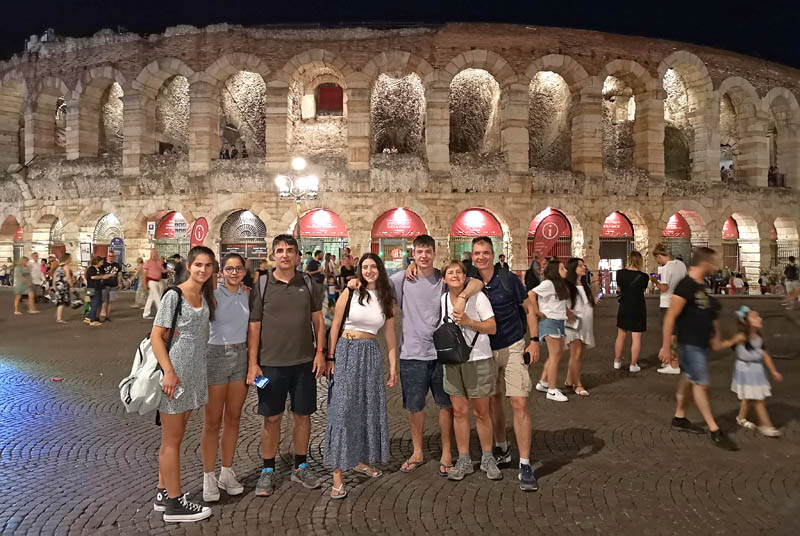
Verona Arena
(in 353 Km.) Verona: After leaving Croatia, we crossed Slovenia and entered Italy, making our way toward Verona. By the time we arrived, night had already fallen. We took advantage of the stop to rest and have dinner. Afterward, we couldn’t resist visiting the Arena di Verona, one of the most remarkable Roman amphitheaters, built in the 1st century AD and still standing as a testament to the grandeur of ancient engineering. Originally designed to host gladiator battles and public spectacles, it could accommodate up to 30,000 spectators. Unlike the Colosseum in Rome, the Arena has retained much of its original structure, allowing visitors to truly appreciate its scale and acoustics. Today, it is world-famous for hosting opera performances, concerts, and cultural events, making it a living monument rather than just a historical site. Seeing it illuminated at night, with its massive stone arches glowing under the city lights, was a breathtaking experience that transported us back in time. Before continuing our journey, we made one last stop at Juliet’s House, where we peeked through the iron gate to catch a glimpse of the famous balcony that has become a symbol of love. Even at night, the courtyard was lively with visitors hoping to experience a touch of Shakespearean romance.
(in 60 Km.) Brescia: We drive a few more kilometres to our last accommodation of the trip. The next day we had just over a thousand kilometres to go home.